
Disclosure
We recommend all products independently of 3rd parties including advertisers. We earn advertising fees from:
• • • • •

• • • • •
Amazon
As an Amazon Associate we earn from qualifying purchases.
• • • • •
DI boxes are a crucial piece of equipment in the studio. No matter how great your instruments or other sound sources are, their quality depends on your signal quality. DI Boxes help ensure your preamp or interface receives a clean signal. This also includes a direct recording signal for electric guitar or bass that can be used for VST plugins or reamping.
Reamping is a process that involves taking a D.I. signal from your computer and feeding it back into an amplifier using a Reamp Box. If you were to go straight from your audio interface, the signal wouldn’t hit the amplifier’s front end like an instrument would. To ensure that the amplifier reacts to the signal appropriately, you need to convert the signal back into one that an amp can understand. This is where a Reamp box comes in handy.
We’ve retained the Reamp Box section from the previous editions since there is still some confusion in forums and reviews. Some people mistakenly purchase regular DI boxes for reamping and vice versa. We want to assist you in making the right purchasing decision. You can read about the differences in the “Things to Consider” section, which will help you find the best DI boxes.
Some may still wonder what a D.I. box is for before diving into our best DI box guide. If you’re new to audio engineering and need a little introduction before purchasing a DI Box (also called Direct Input Box), we’ve got you covered. You can find a primer on what a D.I. Box is and why you might need one (or several) for your studio by clicking here.
The Best DI Box – 2024
| Gearank* | SRC* | Check Price | ||||||
|---|---|---|---|---|---|---|---|---|
| Best Active DI Box | ||||||||
 | Rupert Neve Designs RNDI | 98 | 275+ | |||||
| Budget Active DI Box | ||||||||
 | Samson MDA1 | 95 | 350+ | |||||
| Active DI Box - Stereo | ||||||||
 | Rupert Neve Designs RNDI-S | 97 | 40+ | |||||
| Best Passive DI Box - Mono | ||||||||
 | Radial JDI | 97 | 300+ | |||||
| Budget Passive DI Box | ||||||||
 | Hosa DIB-443 Sidekick | 94 | 350+ | |||||
| Best Passive DI Box - Stereo | ||||||||
 | Radial ProD2 | 96 | 750+ | |||||
| Best Reamp Box | ||||||||
 | Radial Reamp JCR Studio Reamper | 95 | 100+ | |||||
Best DI Boxes - Active
Best Active DI Box - Mono
Active DI Boxes first came to the scene to better capture the sound of electric basses, especially since old bass guitars had weak, passive single-coil pickups. These days, the best di box for bass is still an Active DI, but active DIs are also being used with electric guitars. They are generally considered better sounding because of their higher headroom and extra features. This type is the ideal , if not best Di box for guitar (electric guitars in general).
Rupert Neve Designs RNDI
Cons
- Might be too colored for those seeking transparency
Pros
- Adds harmonic depth to D.I. Tracks
- Top-Tier build quality
- High quality components
Starting in the 1970s, Neve and their preamps and consoles have remained prominent in recording equipment. Not surprisingly, their Direct Box ranks high due to its impressive Gearank Rating, including many experts' recommendations.
The first thing you'll notice about the Neve Direct Box is its high quality. The enclosure, jacks, and switches all feel solidly built and made to last. What sets this unit apart is not necessarily its straightforward Direct Box functionality but rather its amplifier section. It features the same Class-A discrete FET amplifier found on popular Neve consoles.
Because of its design, the RNDI subtly adds harmonics to the signal. This doesn't come as a perceptible shift in EQ but rather as more "depth" thanks to the harmonic content. It's an excellent choice for adding critical tonal elements concerning depth and richness, and the RNDI imparts "preamp-like" characteristics to your sound. Recording multiple tracks with it can help blend instruments in the mix thanks to the similar harmonic content.
However, the RNDI isn't exactly the most transparent. While having more depth from the get-go helps the mix down the line, you might need something else. A warmer and bigger sound is harder to achieve in the mix, and the RNDI provides that upfront.
I highly recommend the Rupert Neve RNDI for bass and guitar, but it can also work well with any instrument. It is easily one of the best bass di box options.
If you want to add more juice to your recordings or even your FOH sound, then the RNDI is highly recommended.
Specifications
- 48V phantom powered active circuitry
- Ground Lift switch for both speaker and instruments
- 1/4" Input and Thru-put jacks, gold-plated XLR output
- Steel chassis
- Weight: 1.5lbs
| Website | Source | *Rating Value |
| Sound On Sound | Bob Thomas | 98/100 |
| Musictech | Editor | 90/100 |
Best Budget Active DI Box
Samson MDA1
Cons
- Jacks feel less than stellar and may need regular cleaning
Pros
- Amazingly solid enclosure for a budget di box
- Great low-frequency extension
- Can be powered by Phantom Power
The Samson MDA1 is a straightforward active direct box that runs on either 48v phantom power or a 9v battery. It can reproduce frequencies as low as 18 Hz, making it an excellent choice for recording bass DI tracks. The solid metal enclosure ensures that it will last for a long time. The MDA1 is built to be sturdy and can last for several years. It can preserve deep subfrequencies with good detail without being too overwhelming. The relaxed low-frequency roll-off is essential for bass tracks.
However, despite the solid enclosure, the jacks are the first to watch out for. They are often the first to fail (although on the MDA1, it is assumed that it will be years before that happens). Luckily, they can be easily serviced or replaced by a technician.
If you're looking for an active direct box that can easily reproduce sub-low frequencies and is built to last, the Samson MDA1 is a great budget option. Another excellent and affordable DI box is the Behringer Ultra DI di400p.
Specifications
- In: 1 x 1/4" (instrument), Out: 1 x 1/4" (thru), 1 x XLR (balanced out)
- Powered by 48V Phantom Power / 9V battery
- Metal enclosure
- -15dB pad and ground lift
Best Active DI Box - Stereo
Active Stereo DI Boxes add life to backing tracks and playback. These are the best direct box types to use for sources like mobile phones, laptops, or tablets. The signal from these sources may suffer a loss in quality over long cable runs from the stage to the mixer and back out the FOH or monitors.
Rupert Neve Designs RNDI-S
Cons
- On the expensive side, but understandably so
Pros
- Tight component tolerances ensure phase coherence
- Solidly built
- Preamp-like harmonics
The Rupert Neve Designs RNDI-S is a stereo version of the RNDI, also covered in this guide. Stereo coherence is crucial for stereo DI, especially while recording stereo sources like loops, keyboards, effects, and samples. When the signal is stereo-matched, phase cancellation and comb filtering are reduced. The better the phase coherence between channels, the better stereo tracks fit into the mix.
Although this stereo di box is one of the more expensive options on our list, many users have praised the RNDI-S for its sonic enhancements, phase coherence, and build quality. The only downside is its price, which may put it out of reach for budget-minded project studios.
If you want to upgrade your already stacked studio, and want a stereo direct box, this may be the slight improvement your workflow/signal chain needs.
Specifications
- 48-Volt phantom powered direct box
- High rail voltage design to avoid clipping
- 80Hz highpass roll-off filter for reducing mud and increases headroom
- Input 1/4", Outputs XLR, 1/4" thru
- Weight: 1.55 lbs
| Website | Source | *Rating Value |
| Gearspace | mikesc | 90/100 |
Best DI Boxes - Passive
Best Passive DI Box - Mono
A Passive Direct Box is the most convenient, practical, and easy-to-use solution for musicians and engineers who want to connect their instruments straight to the console. If you're using guitars and basses with passive pickups, there might be a noticeable drop in the level. However, you can quickly fix this issue by increasing the gain on the console a bit.
Radial JDI
Cons
- Aside from the slightly higher price compared to no-name units? None
Pros
- A truly reliable DI Box
- High quality enclosure and components
- Excellent long-term durability
It's impressive that the Radial JDI has maintained its high Gearank Rating through multiple editions of this guide since 2016. Keyboard virtuoso Chick Corea and artists like Adrian Belew use and recommend the unit, adding to its already superb credibility.
The Radial JDI has no extra features, it's just a di box, but it performs its primary function excellently - removing ground hum and noise while allowing your instrument or amplifier signal to reach the PA system with the cleanest and clearest sound. Being passive, it works well with active pickup-equipped guitars and basses, amplifiers, and other electronic instruments, including keyboards and laptops.
Compared to other DI boxes, this unit has no significant issues, contributing to its perennial position on our guides. The only downside, however, is its price, which may need to be more affordable for the most frugal.
The Radial JDI is more than just a great DI Box; it is arguably the best all-around Direct Box in the market today. If you are a multi-instrumentalist trying to figure out what to get or a sound engineer who deals with various sound sources, the Radial JDI is the one to choose.
Specifications
- Passive mono Direct Box design with Jensen Transformers.
- -15dB input pad.
- Merge Function
- Single 1/4" input, single XLR, and one TS Thru output
- Welded I-beam construction.
- Weight: 2.2 lbs
| Website | Source | *Rating Value |
| Sound on Sound Forums | Arthur Stone | 98/100 |
Best Budget Passive DI Box
Hosa DIB-443 Sidekick
Cons
- Only has the essentials; no additional features
Pros
- Very rugged and well-built for the price
- Instrument/Line switch adds a bit of versatility
When you're looking for an affordable and dependable Direct Box, it can be challenging to choose one as there are so many low-quality products in the market. However, the Hosa DIB-443 Sidekick is a reliable, high-quality option that won't break your budget.
This DI Box has an instrument/line level switch that allows you to adjust the sound source as needed. It is a simple but effective tool that is built to last.
There's not much to complain about for the price, but if you need additional features like a pad, consider a higher-priced option.
You don't have to compromise on durability or quality if you're on a tight budget. The Hosa DIB-443 Sidekick is a sturdy DI Box that will get the job done.
Specifications
- Passive D.I. Box with instrument/line level switch
- Solid Steel enclosure
- Input: 1 x 1/4"
- Weight: 0.80 lbs
| Website | Source | *Rating Value |
| Youtube | The Angry Sound Tech | 96/100 |
Best Passive DI Box - Stereo
Passive stereo direct boxes do not provide the same lively tonality as active DI boxes. However, they provide a soft high-frequency roll-off and hard transient suppression due to the absence of any other electrical source interfering with the signal. Most designs have achieved relative transparency without requiring external power.
Radial ProD2
Cons
- None as long as properly maintained / cleaned
Pros
- Good stereo matching
- Transient smoothing helps manage sudden jumps in signal like slap bass
- Very tonally transparent
Radial Engineering unquestionably dominates the market for the best DI boxes with its wide range of options catering to almost every situation. The ProD2 is a transparent, 2-channel D.I. box ideal for keyboards, program material, and other high-output sound sources. It is designed to smoothen out extreme transients while retaining most of the input. This helps prevent overloading the mixer or audio interface's preamp.
The ProD2's transparent sound quality helps smooth out harsher transients and background noise without significantly altering the input sound. Unlike other direct boxes that may color the sound in obvious ways, the ProD2 remains faithful to the input while rounding out any excess digital "harshness."
If well-maintained, the Radial ProD2 can last you a long time. It is recommended to clean the contact points periodically to prevent signal loss and scratchiness, as with all electronics.
Overall, Radial Engineering once again offers a winning product with the ProD2. It ticks all the boxes of what a good stereo D.I. box should be, bringing out the best in your instruments.
Specifications
- Full range passive direct box with Eclipse ET-DB2 transformers
- Very low harmonic and phase distortion
- 14-gauge steel welded I-beam construction
- -15dB pad
- Input 2 x 1/4", Outputs 2 x XLR, 2 x 1/4" thru
- Weight: 1.95 lbs
| Website | Source | *Rating Value |
| Youtube | A Minor Error | 90/100 |
Best Reamp Box
Reamping is a technique that is frequently used in modern recording studios. It involves taking a clean DI guitar recording and running it through a Reamp box, which converts it into a signal that can be fed into a guitar amplifier as if the music was being played directly from an instrument. This preserves the amplifier's response and allows for the re-recording of guitar parts using different equipment, microphones, and mic placement, even if the original session musician is unavailable.
Radial Reamp JCR Studio Reamper
Cons
- Might interact strangely with fuzz pedals
Pros
- Adds subtle harmonics to raw D.I. for added depth
- Reamped tone similar to going through a high quality buffer
- Simple to use
The Radial JCR is a passive reamp box designed by John Cuniberti, the inventor of the Reamping process. It is a must-have studio tool for modern music production if you want to easily reamp studio-recorded guitars.
Compared to other reamp boxes, the JCR uses high-quality components that add musical harmonics over the original guitar tone, much like using a boutique buffer or clean boost in the signal chain. However, it may not be the best option if you're looking for absolute transparency.
Additionally, some fuzz pedals may not respond properly to reamping, so it's something to remember when using a pedalboard.
The JCR is the definitive single-channel reamp box that reigns supreme in its category. If you want to reamp to a stereo signal chain like reverbs and delays, then the Radial X-amp might be more for you.
Specifications
- Passive design re-amping box with custom transformer
- 14-Gauge steel welded I-beam construction
- Handy ground lift switch, Phase inverter, Mute switch, Tone Control
- Input 1 x XLR, 1 x TRS, Outputs 1 x 1/4" TS
- Weight: 2.2 lbs.
| Website | Source | *Rating Value |
| Youtube | Spiffo Smith | 90/100 |
Things to Consider when Buying a DI Box
- The main job of a D.I. Box (also called DI Box or DIbox) is to convert your instrument lead (1/4" TS) signal 'directly' into the microphone inputs (balanced 3-pin XLR) that a mixing consoles typically has. Unlike a simple headphone adapter (1/4" to 1/8"), it doesn't just change the size or shape of the connectors. Instead, it converts the differences in impedance and voltage between the two sides of the connection to achieve a balanced signal. This process can affect the tone of your instrument (in a good or bad way), and that's why choosing the suitable DI Box is crucial. The details of how it does this are beyond the scope of this guide but if you want to delve further into the topic then look at this DI article on Wikipedia
Apart from transmitting the signal to the desk, a DI Box (Direct Box, Direct Input, or Direct Injection Box) has several other advantages. The balanced XLR connection is much better for running cables over long distances without picking up noise and interference. For example, guitar leads can lose some sound quality at around 20 feet (6m), so a balanced XLR cable from the Direct box is a better option if you want to cover more distance. Secondly, many DI boxes (especially passive ones) isolate the input and output circuits, which can help prevent ground loop hums and other electrical noise from creeping into the sound system.
- There are two types of DI boxes: Passive and Active. Passive DI boxes do not require an external power source, while active direct boxes need phantom power, a battery, or a separate power supply. Active D.I. boxes offer better functionality and improved sound quality, whereas Passive Direct Boxes offer simple functionality without worrying about the power supply. The basic rule is to use an Active D.I. Box for instruments with passive pickups and a Passive Direct Box for instruments with active pickups and electronics. To determine if your instrument is passive or active, check if you have to supply power or insert a battery. If you do, it's active; otherwise, it's passive. This is why a good passive unit is the best di box for acoustic guitar. While an active unit is a great DI box for passive electric guitars and electric basses.
- A D.I. Box is a device that converts the unbalanced high-impedance output of an instrument to a balanced low-impedance signal that can be sent to a mixer or recording interface. The most basic form of a D.I. Box typically has one input and one output that goes straight to the mixer. As the price increases, they offer more options, including a separate output for amp or monitoring. Some even have multiple input/output options for complex rigs and multiple instruments. Selecting a D.I. Box with the right amount and type of input for your needs is crucial. A straightforward compact DI Box will be more than enough if you use a single instrument like an electric bass guitar or acoustic guitar.
- Managing multiple music equipment can lead to voltage differences and ground loops, resulting in hum and noise. Passive DI boxes and transformers offer automatic ground lifts that instantly reduce noise and hum. This makes them essential for keeping stages and studios sounding clean and quiet. Active Direct Boxes also provide this feature, with some featuring a ground lift switch separating the signal ground from the unit's chassis ground. This feature is one of the reasons why pros will often have a guitar DI box in their tool kit.
- As previously mentioned, if you need more features and connectivity options in your device, it will require more space, thus increasing the enclosure size. Therefore, it is crucial to find a device with all the necessary features and connectivity options that suit your needs and are also comfortable for you to use or carry around.
- Selecting a box that caters to your needs is recommended, as both devices have different functions. Direct boxes transmit signals into a recording interface or mixer, while reamping DI boxes convert pre-recorded signals and send them into amplifiers or effects processors. It is important to note that these require a different impedance level than mixing consoles.
So what is a DI Box for, and what does a DI Box do?
Passive vs Active DI Boxes
Input/Output Ports
Ground Lift Switch
Size
Are Regular DI Boxes and Reamp DI Boxes Interchangeable?
Best DI Box Selection Methodology
The first edition was published in 2016. The current edition was published on Feb 6, 2024.
For this edition, we've expanded our list of viable DI boxes to 50. We then gathered relevant and current ratings, reviews, and recommendations from experts and artists. Over 20,400 comment, rating, and review sources were fed into the Gearank Algorithm, resulting in rating scores out of 100. We've categorized the best DI boxes into five categories: Active Mono, Active Stereo, Passive Mono, Passive Stereo, and Reamping. We've also included budget-friendly DI Box options for passive and active models with reasonable ratings. For more information on our methods, check out How Gearank Works.
About the Author and Contributors
Here are the key people and sources involved in this guide's production - click on linked names for information about their music industry backgrounds.
Lead Author & Researcher
Raphael Pulgar
I've been an audio engineer for 20 years specializing in rock and metal recordings. I also play guitar and produce original music for my band and other content creators.
Some of the recording gear I use in my studio includes the Focusrite Scarlett 18i20, Focusrite Scarlett Solo, Samson QH4 Headphone Amp and Cloudlifter CL-1. My mics include Aston Origin, Aston Element, Shure SM57, Rode NT1, Rode PodMic and MXL V67G.
Contributors
Alexander Briones: Supplemental writing and editing.
Jason Horton: Supplemental research, Editing and Illustrating.
Media
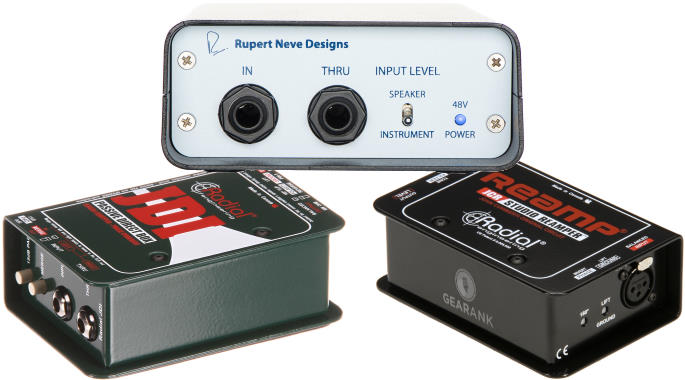
Main/Top Image: By Gearank.com using photographs of the Radial JDI, Rupert Neve Designs RNDI and Radial Reamp JCR Studio Reamper.
The individual product images were sourced from websites, promotional materials or supporting documentation provided by their respective manufacturers.




The following items came off our recommended list when we published the November 2022 Edition:
Publication of our November 2021 Edition resulted in the following DI’s coming off the recommended list above:
Our November 2020 update resulted in the following boxes coming off the recommended list above, but you can still see our analysis of them:
I’m surprised to not see the Countryman Type 85 get a mention for active mono DI boxes. It’s a personal favorite of mine. Great neutral sound, roadworthy construction, and flexibility in use with its ability to accept speaker-level signals.
The Countryman Type 85 was on our recommended list from the time we first published this guide back in 2016 until November 2019, but times move on and although it’s still a good active DI, there are now more highly rated options available which we chose to recommend instead.
As a result of our November 2019 update the following DIs came off our recommended list above but you can still read our analysis of them:
Hi, I have a Scarllet 2i4 interface and when I record electric guitars I get some noise coming from the Pickups. My question is: would a DI Box solve that problem or the actual interface has already its own DI inside? If a new DI solve that problem wich one would be better? active or passive? Thank you
Hi Pedro,
Noise during recording is usually compounded from multiple sources and factors. Unshielded cavities on your guitar + single coils is instantly a recipe for buzzing/hum. A bad cable can also be the cause. Some pickups, even humbuckers, are wound in a way that the two coils dont completely cancel out hum. There is also the question of how clean the power in your area is. Some establishments and houses have poorly planned electronics which contributes to noise especially when using pedals.
Your Focusrite is probably fine since the signal is converted from unbalanced to balanced internally. A d.i. usually solves the problem of Ground Noise and if you want to use a d.i. make sure it has a ground lift switch. What d.i.’s don’t solve is accumulated noise from the sources I listed above. If you notice, the hum may lessen or disappear when facing a specific direction. This may be because you are near an electric device like a CPU or an electric fan. Putting your guitar close to a stepdown/stepup transformer can also contribute to that.
My advice is to test everything one by one. Are you using single coils? Try a humbucker guitar. Are the cavities of your guitar shielded? Check to see with a guitar that you know is shielded. Is your cable working right? try different cables. Is the power in your house/studio clean and conditioned? Turn your appliances off or on and see if it makes popping noises when you have your guitar turned up with some distortion.
A d.i. is handy to keep around for its utility in being able to use an amplifier and your entire rig for recording while having a dry signal go to your computer for recording. Using an ordinary splitter can affect the strength of your signal going into your rig and into the interface. A d.i. box solves this by passing your signal through one end while the other is converted into a balanced signal.
Hope this helps.
-Raph
Hi Raph,
Thank you so much for your detailed insights! My guitar is HSH and I believe is shielded (At least on the back side I see a wire solded to the tremolo. I know that single coils can cause some issues, so I avoid to use them. With the bridge pick-up I don´t have any problem at all but when I´m using the neck humbucker there´s almost always some hum that get´s worse if I switch on a desk lamp for instance. So, as you said, has maybe something to do with the electric devices around. I read above that passive DI are better than active ones on these hum problems but on the other hand active ones should be used with passive pick-ups (my case). What would be your advice in this situation? Thank you
Hi Pedro,
Since there might be some issues with the power filtering in your area, I would advise using a good Passive D.i. instead of an active d.i. While pairing a guitar with passive pickups with an active d.i. would result in a slightly stronger signal to the interface, it would come at the risk of adding noise because of the power conditions in your area especially with less than optimal circuit designs.
I see no disadvantage of owning both if they are within budget.
-Raph
Ok, Thank so much Raph! Appreciated.
As a result of our December 2018 update the following DI Boxes came off our recommended list above but you can still read our analysis of them:
It seems like the best sounding DI for guitars has either been overlooked or simply avoided. The SANSAMP has yet to meet it’s match in price/versatility/durability/reliability!!! I have the GT2, Para Driver DI, and the TRI A.C. and one of them is always in my gig bag. Para Driver is the only one I have with XLR outs, but the other two can 1/4″ directly into DAW or console. Can’t beat THAT with a stick!!!
What, no L.R. Baggs products?? Their Para Acoustic DI (PADI) is still the best sounding DI I have ever used! I have several as I play several instruments (some have multiple pickups in them).
I have not tried their newer Session DI yet, but by reputation it should do nicely also.
You really should add Baggs to the list. The PADI is however (in my opinion) the gold standard for a DI for Acoustic Guitars (also works great on Bass)! I’ve used it on my electric too with good results (I prefer a clean sound with little to no effects, so it still works in my case, those who like many effects may understandably not agree)!
Its Parametric EQ is quite effective and the sound I get when running my instruments through it (Guitar and Banjo) is regularly complimented on by sound techs at the venues I play at.
If you haven’t done so yet, I challenge any Acoustic guitarist to try the PADI! They are very well built for a reasonably good price-point.
Our research agrees with you – we just have those products classified a bit differently:
The LR Baggs Para DI, LR Baggs Session DI and LR Baggs Venue DI are all featured in our guide to Acoustic Preamps.
People are happy paying 750.00 for a reddi direct box? nonsense.
They clearly dont run sound and have never had a di stolen or lost. lose one or two of these and the price becomes an issue. in a live situation, you wont hear the difference between a 100 or 1000 di.