
Disclosure
We recommend all products independently of 3rd parties including advertisers. We earn advertising fees from:
• • • • •

• • • • •
Amazon
As an Amazon Associate we earn from qualifying purchases.
• • • • •
If you’re into music production, you might want to consider getting a 500 series compressor to enhance the quality of your audio recordings. But with so many different types and models available, it can be hard to know which one is right for you.
To make things easier, we’ve done some research and put together a list of the best 500 series compressors for 2024. We’ve looked at ratings and reviews from people who use them, and we’ve chosen the top-rated compressors in different categories, such as for single-channel recording, mixing, live performances, and different budgets.
We’ve also added some information about the different types of compressors, what they’re used for, and what you should consider before buying one. Whether you’re a beginner or an experienced producer with a big mixing board, we’re confident you’ll find a compressor that will work for you in this guide. Keep reading to learn more!
The Best 500 Series Compressors – 2024
| Gearank* | SRC* | Check Price | ||||||
|---|---|---|---|---|---|---|---|---|
| Single Channel Compressors | ||||||||
 | Rupert Neve Designs 543 | 93 | 20+ | |||||
 | Rupert Neve Designs 535 | 93 | 20+ | |||||
| Budget Option Under $500 | ||||||||
 | dbx 560A Compressor/Limiter | 92 | 80+ | |||||
| Stereo Bus Compressor | ||||||||
 | WesAudio _DIONE NG500 | 93 | 20+ | |||||
Author & Contributors
Raphael Pulgar
I've been an audio engineer for 20 years specializing in rock and metal recordings. I also play guitar and produce original music for my band and other content creators.
Single Channel Compressors
Rupert Neve Designs 543
Cons
- Meters are a bit small
Pros
- Feed-forward and feed-back modes
- Versatile modes and parameter controls
- Precise attack and release adjustments
- Built-in meters
The Rupert Neve Designs 543 brings the response and vibe of the Portico 5043 in a 500 series format. It features a custom designed transformer that adds the popular "Neve" character to your program material, great for drums, bass.
With feed-forward / feed-back controls, Peak / RMS Detection, and a high pass filter for sidechaining, the 543 gives a wide array of control over your processing. Feed-forward allows for more subtle compression, while feed-back allows the unit to go all out. This feature alone expands the usability of this compressor by a lot. Getting a good handle of its controls will allow you to smoothen harshness in your track, and sweeten the attack and response to taste.
Being able to precisely adjust attack and release is another positive trait of the 543. It also comes with nifty meters that provide good visual feedback. The meters are a bit small though, but given the size of the unit, it's on point.
If you're a fan of the "Neve sound" and want a dynamics processor that gives your tracks a smooth character with just the right amount of harmonics to sound clear, the Rupert Neve Designs 543 is a great module to add to your collection.
Specifications
- Controls: Threshold, Ratio, Attack, Release, Gain
- Maximum Input Levels/Output Levels: +28dBu.
- Attack: 20ms to 75 ms
- Release: 100ms to 2.5 sec
- Ratio: 1:1 to 40:1
- Threshold: -30dBu to +20dBu
| Website | Source | *Rating Value |
| Sound On Sound | Hugh Robjohns | 95/100 |
| MusicTech | Mike Hillier | 90/100 |
Rupert Neve Designs 535
Cons
- Complex controls
Pros
- Premium quality studio compressor
- Works great with drums and vocals
- Low noise floor
- Precision control over compression parameters
The 535 module is a 500 series equivalent of the sought-after Neve 2254 compressor with a few modern updates. Compared to the original, it has been engineered for a lower noise floor, new timing control, stepped controls and internal parallel processing.
The lower noise floor makes it viable for the clean requirements of modern recording, while the expanded controls allow for more precise application of compression to your tracks. The main downside to its expanded control is a steeper learning curve, but not by much compared to the original.
With custom transformers and a class-A amplifiers, the 535 puts classic Neve punch to your 500 series rack. This compressor works great with drums and vocals. On drums, it tightens up the Bass with no compromise of impact while retaining the shimmer of cymbals and detail of snare wires. On vocals, it adds a smooth compression quality while adding a bit of characteristic sheen that Neve components are known for. You can also use two together for gluing mixes together in stereo.
Get that classic Neve clarity and sheen with dynamic processing from the versatile Rupert Neve Designs 535 Compressor.
Specifications
- Controls: Threshold, Ratio, Timing, Blend, Gain
- Attack: Preset matched with release / Auto
- Release: Preset matched with attack / Auto
- Ratio: 1.5:1 to 8:1
- Threshold: -25dB to +20dB
| Website | Source | *Rating Value |
| Sound On Sound | Hugh Robjohns | 94/100 |
| TapeOp | Geoff Stanfield | 96/100 |
Budget Option Under $500
dbx 560A Compressor/Limiter
Cons
- Lacks character (sound coloration)
Pros
- Hard knee and soft knee modes
- Program-dependent attack and release settings
- Easy to get good settings
- Versatile features and parameters
The 560A is a dual mode dynamic compressor, with traditional hard knee mode, and dbx's soft knee mode called "OverEasy". These two modes expand the ways that you can use the compressor, and in ways that are quite intuitive, thanks to dbx's program-dependent attack and release timings.
It is a dynamic processor that has a smooth and transparent sound, with real RMS level detection. More importantly, you don't need to spend too much time to dial in good sound. It's interesting how intuitive it is even with its expanded myriad of settings that include ratio, threshold and output. Being a transparent compressor means that it lacks "character", so if that is you're thing, then this may not be for you.
One noteworthy feature is the "Infinity Plus" inverse-compression, which lowers the audio output level when the input crosses the threshold beyond unity gain. This is a handy tool for regulating mix levels of extremely loud inputs in live performances and recordings.
All in all, the dbx 560A is a good versatile compressor to have that's accessibly priced. Definitely worth checking out.
Specifications
- Controls: Threshold, Ratio, Output
- Maximum Input Levels/Output Levels: +22dBu
- Attack: 15ms for 10dB, 5ms for 20dB, 3ms for 30dB
- Release: 8ms for 1dB, 80ms for 10dB, 400ms for 50dB; 125dB/Sec Rate
- Ratio: 1:1 to infinity: 1, to -1:1
- Threshold: -40 dBu to +20 dBu
| Website | Source | *Rating Value |
| TapeOp | Geoff Stanfield | 98/100 |
| Bonedo (German) | Hannes Bieger | 90/100 |
Stereo Bus Compressor
WesAudio _DIONE NG500 Analog Bus Compressor with Digital Recall
Cons
- Beyond the average budget of home studios
Pros
- Blends digital brain control with analog sound
- Convenient hybrid workflow
- Fits modern studio setups
- Great saturation options
The DIONE NG500 is a beautiful blend of Analog sound with Digital flexibility. It is able to store, recall and control analog hardware directly from a DAW, as well as follow automation done in the box.
This is topped off with THD options for saturation, sidechain filters for finer control of how the compressor acts around bass frequencies and a mix knob for parallel compression. The THD options are really good, there's not a bad sound to be had.
The flexibility of this unit is its main highlight, especially when integrated into the DAW as part of a hybrid workflow. Being able to work with hardware and controlling it in the box is very convenient.
The DIONE NG500 is a great tool for people who like to mix in the box but want an analog compressor that they can integrate into their workflow. The saturation options and fast attack make it great as a final compressor to glue your tracks together.
Specifications
- Controls: Threshold, Attack, Release, Mix, Make Up
- Input/Output Impedance: 10kohm/<100ohm
- Maximum Input Levels/Output Levels: +24dBu
- Attack: 0.1ms, 0.3ms ,1ms, 3ms,10ms, 30ms
- Release: 0.1s, 0.3s, 0.6s, 0.9s, 1.2s, Auto
- Ratio: 1.5, 2.4, 10
- Threshold: -21dB to +21dB
| Website | Source | *Rating Value |
| Sound On Sound | Hugh Robjohns | 94/100 |
| Gearspace | Dowsed | 100/100 |
Things To Consider When Buying A 500 Series Compressor
VCA
Voltage Controlled Amplifier compressors allow control of faster attack and release parameters. A lot of plug-in compressors are based on the VCA type since it's the most used type of compressor. Their response curve is mostly linear (hard knee), but some have built-in soft knee to adapt them to mixbus compression purposes. They use IC chip-based transistors that determines input voltage to control gain reduction results, which gives the compressor a clean and controllable characteristic that people look for.
Optical
Optical or Opto compressors use a light source to determine gain reduction. How bright the built-in light source is determines the intensity of the incoming signal voltage. These compressors use photocells as a detector to determine the amount of compression that is applied. They are less sensitive to transients, peaks and sudden spikes meaning much higher ratios can be used. They tend to have natural smoothness in response time due to the inherent delay of triggering the attack and release of the compressor.
Variable-MU
Variable-MUs are tube-based compressors known for their tone and warmth. Their design uses input voltage changes to alter the bias of the tubes that controls the gain-reduction stage. They tend to have a “soft-knee” and "slow-attack" style that produces a more smooth compression. Their ratios are program-dependent and increase with the gain reduction. This means the louder a transient is, the harder the compression. They have a slower and less impulsive response time compared to FET and VCA compressors.
FET
Field Effect Transistor compressors provide highly colored versions of compression and fundamentally are a subset of VCA compressors. Compared to Variable-MU and optical options, they have more control on grabbing harsh transients. They are often used as a solid-state emulation of tubes and have a much faster response when it comes to compression. Their trademark sound produces a punchy and full of imbued character.
- Hard knee compression is when the compressor immediately reduces the signal once the it hits the threshold. This type of compression is commonly used if you want to reduce transients right away and is suitable to use on instruments such as snare drums. On the other hand, soft knee compression occurs when the signal is gradually reduced after the signal exceeds the threshold. This is for a more natural-sounding compression and recommended to use on sustaining instruments such as strings.
- Choosing an Audio Compressor is based on how to maximize its uses, and what type of sound you would want to achieve. VCA compressors usually control transients and give transparency and aggression in the mix. VCA compression is useful for recording percussion to provide a precise and punchy sound. Mixing, mastering, and tracking are factors taken into account when choosing which type of compressor is best suitable for each process. For example, FET compressors are not recommended to use for mixing and mastering since they produce colorful sound characteristics. Since they are known for aggressive and quick attacks, they are more suitable for tracking and parallel compression. On the other hand, optical compressors are preferably used to compress any sound source naturally such as vocals, strings, and bass. Tube-based and stereo compressors often are used for mastering purposes to make the mix sound smoother and homogeneous. You can also use the different compressor types for sidechain compression.
Types of compressors
Hard Knee Vs Soft Knee Compression
Different Uses and Sound
Best 500 Series Compressor Selection Methodology
The first edition was published in 2017.
For this edition we looked at all the 500 Series Compressors available from major American online retailers and short-listed 24 of the most popular for detailed analysis. We then examined over 490 ratings and reviews from users and experts as well as forum discussions to get the data we processed with the Gearank Algorithm to produce rating scores out of 100 for each one. We selected the highest rated compressors in each category above to recommend. For more information about our methods see How Gearank Works.
About the Author and Contributors
Here are the key people and sources involved in this guide's production - click on linked names for information about their music industry backgrounds.
Lead Author & Researcher
Raphael Pulgar
I've been an audio engineer for 20 years specializing in rock and metal recordings. I also play guitar and produce original music for my band and other content creators.
Some of the recording gear I use in my studio includes the Focusrite Scarlett 18i20, Focusrite Scarlett Solo, Samson QH4 Headphone Amp and Cloudlifter CL-1. My mics include Aston Origin, Aston Element, Shure SM57, Rode NT1, Rode PodMic and MXL V67G.
Contributors
Alexander Briones: Supplemental writing.
Jason Horton: Editing and Illustrating.
Media
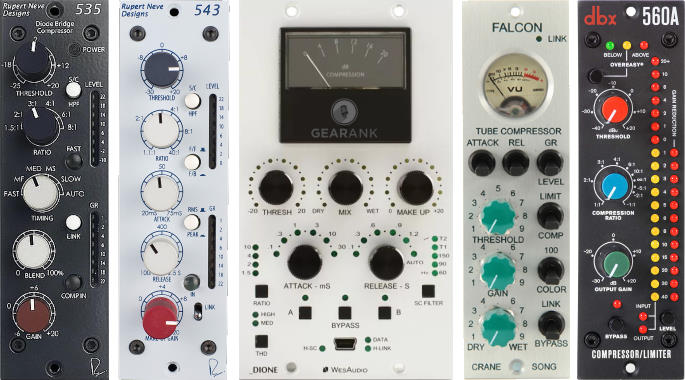
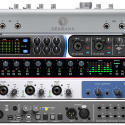
Main/Top Image: Created by Gearank.com using photographs of the Rupert Neve Designs 535, Rupert Neve Designs 543, WesAudio DIONE, Crane Song Falcon and dbx 560A.
The individual product images were sourced from their respective manufacturers' websites, promotional materials or supporting documentation.



Publication of our November 2022 Edition resulted in the following compressors coming off our recommended list:
We’ve removed the FMR Audio RNC500 from the recommended list due to it being discontinued.
We’ve removed the BAE 500C due to becoming discontinued.
Publication of our December 2021 Edition resulted in the following compressors coming off the recommended list above:
Great resource.
Very well thought out and executed!!
The following compressors have been removed from the recommended list above as a result of our December 2020 update, but you can still see our analysis of them: