
Disclosure
We recommend all products independently of 3rd parties including advertisers. We earn advertising fees from:
• • • • •

• • • • •
Amazon
As an Amazon Associate we earn from qualifying purchases.
• • • • •
MIDI Keyboard Guides
We have a range of helpful keyboard guides for you:
As retail sites get populated with OEM and unknown brand MIDI controllers, more established manufacturers have started offering budget lines to fill in the need for high quality, full featured MIDI Controllers at prices a hobbyist or beginner can afford.
These days, even affordable MIDI controllers have full features and can fill in the need for backup or touring gear. Others are capable of controlling older hardware synths with 5-pin MIDI. On the upper end of the budget range, some even have assignable controls and pads.
There’s an interesting twist in this edition: Arturia’s MiniLab MkII took the highest rated spot from Arturia’s MicroLab – Arturia is definitely the dominant brand in the sub $100 price range!
The Best Budget MIDI Keyboard Controllers – 2024
| Gearank* | SRC* | Check Price | ||
|---|---|---|---|---|
 | Nektar SE25 | 90 | 350+ | |
 | Arturia MicroLab | 93 | 325+ | |
 | MidiPlus X2 Mini | 90 | 70+ | |
 | Nektar SE49 | 90 | 1300+ | |
 | Arturia MiniLab MkII | 94 | 3550+ |
Author & Contributors
Raphael Pulgar
I've been an audio engineer for 20 years specializing in rock and metal recordings. I also play guitar and produce original music for my band and other content creators.
Nektar SE25
Cons
- No extra controls
Pros
- Minimalist design
- Compact and portable
- 3 Velocity sensitivity options
- Fast and responsive synth action keys
The Nektar SE25 is a minimalist MIDI Keyboard controller, with a width of 13.18", nearly as wide as laptops.
This size makes it compatible with conventional laptop bags and backpacks, making it a good portable solution for musicians on the go.
Since it doesn't have extra knobs and buttons, Nektar is able to focus on the keys, resulting in playing feel that is as good as more expensive controllers. You can choose from 3 velocity curves that fit to your playing style.
At 0.88lbs, its also one of the lightest controllers we recommend.
The downside to its minimalist design is the lack of extra controls for parameter tweaking.
If you are looking for a simple, key-focused MIDI controller with a pedigree, then this is the best budget MIDI keyboard for you. On the other hand, if you like this controller but need more keys, check out the Nektar SE49 below.
Specifications
- Keys: 25 Velocity Sensitive Synth Mini-keys with 3 velocity curves
- Pads: None
- Controls: PB1, PB2 (assignable to Pitchbend, Pan, Transpose), S Buttons (sustain, modulation)
- Octaves: -4 to +4
- Bundled Software: Bitwig Studio 8-track
- Power: USB Bus Powered
- Connectivity: 1 x USB Type B
- Compatibility: OS X 10.7 or Later, Windows 7 or later
- Dimensions:13.18" x 0.82" x 3.93"
- Weight: 0.88 lbs.
| Website | Source | *Rating Value |
| YouTube | John Mike | 90/100 |
Arturia MicroLab
Cons
- Limited controls
- Touch strip is not everyone's cup of tea
Pros
- Compact and portable
- Rugged build
- Compatible with different class compliant devices
- Touch strips for pitch bend and modulation
Arturia's Microlab is a compact, budget-friendly 25-key controller with some extra controls on the side. These extra controls include two Touch Strips that allow for expressive real time control like pitchbend and modulation. And the strips can also be used for preset browsing.
Compared to its bigger siblings, it doesn't have knobs and the buttons provided are sparse. So those who are looking for knobs, buttons and more tweaking options will have to look elsewhere.
More importantly, it carries all these features while maintaining a small size that doesn't take much space.
Build quality is surprisingly rugged for the price and the included software bundles get you up and running fast.
Compatibility is good, it connects with anything from tablets to other class-compliant devices. Its low power consumption enables it to work even with mobile devices without external power. The Arturia MicroLab is a portable MIDI keyboard option for on-the-go musicians and producers.
Specifications
- Keys: 25 Velocity Sensitive Synth action, Mini-keys
- Pads: None
- Controls: 2 x Touch Strips (pitchbend, modulation, preset browsing)
- Octaves: -4 to +4
- Bundled Software: Bitwig 8-Track, Arturia Analog Lab Lite, UVI Grand Piano Model D
- Power: USB bus power
- Connectivity: USB
- Control Hardware Directly: No
- Compatibility: OS X 10.10 or later, 64-bit , Windows 7 SP1 or later, 64-bit
- Dimensions: 21.9" x 5.4" x 1.6"
- Weight: 3 lbs.
| Website | Source | *Rating Value |
| MusicRadar | Jon Musgrave | 90/100 |
| MusicTech | Dave Gale | 90/100 |
MidiPlus X2 Mini
Cons
- Its mini keys require some getting used to
- Touch strip is not everyone's cup of tea
Pros
- Expanded controls
- Pitch Bend and Modulation via Touch Strips
- Streamlined look
- Durable metal chassis
Midiplus is a Taiwanese Company specializing in MIDI based Music Gear. The X2 Mini is their 25-key offering in their compact key range.
The X2 mini features 25 velocity sensitive mini keys that are built really well for the price. While it is sized like a toy, it has the playing feel of an instrument, complete with velocity sensitivity.
It has extra controls that include four customizable knobs, and a number of buttons, which give it an important edge over other micro sized controllers like the Korg nanoKEY2. It also has pitch and modulation control via capacitive touch strips, which requires a bit of familiarization to better utilize, especially if you're used to rotary or pitch mode wheels.
I'm not a fan of the cramped feel of mini size keys, but this is a necessary compromise given the size and control options that the X2 Mini provides.
Surprisingly, it is able to accommodate these extra controls while keeping a streamlined look and compact profile. In addition to using smart computer devices, you can use the X2 Mini to control analog synths via its 5-pin MIDI out.
MidiPlus equipped it with a metal chassis making this the best cheap MIDI keyboard when it comes to build quality in this price range.
Though not as popular as other MIDI controllers on the market today, for the price, the MidiPlus X2 Mini delivers a lot of quality and utility.
Specifications
- Keys: 25 Velocity Sensitive Synth Mini-keys
- Pads: None
- Controls: Pitch and Modulation control - capacitive touch sensitive strips, 4 customizable knobs; Default setting: T1 (Volume), T2 (Pan), T3 (Expression Controller), T4 (Reverb)
- Octaves: up/down with transpose
- Bundled Software: None
- Power: USB Bus Powered
- Connectivity: USB Type B
- Compatibility: OS X 10.7 or Later, Windows 7 or later
- Dimensions: 16.1" x 2.01 x 5.39
- Weight: 3.4lbs.
Nektar SE49
Cons
- Keys are stiffer than usual
- With 49 keys it takes up a bit more space
Pros
- 49 full-size keys with tactile feel
- 4 velocity options
- Mod and Pitchbend Wheels
- Streamlined design
The SE49 is the larger 49-key sibling of the 25-key SE25. It features specially designed full-size keys that provide tactile feedback, this time with more notes to play with. This means that it is longer and takes up a bit more space, but it is still reasonably portable.
It has 4 different velocity curves that go from soft to hard. The feel of the keys and the ability to choose its touch response (velocity curve) makes the SE49 easy to setup to match your preferred playing feel. Note that the keys are a bit stiffer than the usual synth keys, this can be good or bad, depending on your preference. The bundled software is also quite good.
It has a streamlined profile with just a few extra controls on the left side. Speaking of extra, it is equipped with two wheels for real time modulation and pitch bend control.
The Nektar SE49 is the best MIDI keyboard for people who want a MIDI controller with great feel, full size keys and simple controls.
Specifications
- Keys: 49 Synth-action keys wit 4 velocity curves
- Pads: None
- Controls: Pitch Bend and Modulation Wheels, Octave and Transpose Buttons, Volume Fader
- Octaves: -4 to +4
- Bundled Software: Bitwig Studio 8-track
- Power: USB bus power
- Connectivity: 1 x USB Type B, 1 x Sustain Pedal Input
- Control Hardware Directly: No
- Compatibility: Windows and Mac OS X 10.10 or later, 64-bit , Windows 7 SP1 or later, 64-bit
- Dimensions: 31.69" x 7.75" x 2.5"
- Weight: 4.85 lbs.
| Website | Source | *Rating Value |
| Audio Mentor | Reuben Chng | 90/100 |
Arturia MiniLab MkII
Cons
- Knobs feel cheap
- Touch strips feel like a compromise
- Pads are a bit small
Pros
- Great value for money
- Lots of encoders and pads
- Synth action keys feel great
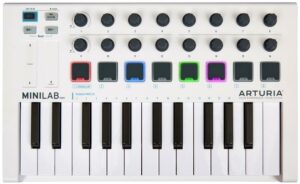
Arturia's entry into the affordable 25-key MIDI controller arena got a facelift in 2016. This MkII has an updated layout and smaller footprint than its predecessor.
Build-wise, the MiniLab MkII feels solid. Even though it's made of plastic, I didn't feel any excess plastic residue and everything feels solid with no internal rattle when I shake it. The keys are finished nicely and the resistance is just right for synth action. There were some keys that were fractions of an inch higher or lower than the others but it's not really a major issue. The knobs felt a bit flimsy to the touch but the potentiometer rotation is smooth and consistent across all knobs. The pads felt a bit small but I rarely use them. Still, if you like making beats on pads, the layout and size might not be the best especially for harder hitters.

In place of a regular mod and pitch wheel are two touch strips.
What I don't like about the Minilab MkII is the fact that I had to settle with touch strips instead of pitch and mod wheels. I would have preferred even a smaller integration of the two wheels as long as it's mechanical. The strips work fine but I do feel it lacking in precision especially when my left hand's fingers are calloused from guitar playing.
The unit was plug and play and my Digital Audio Workstation (DAW) - Presonus Studio One - instantly recognized it as a new device. Arturia provides a bundled software suite that automatically maps to the encoders and pads. Manual mapping for other software synths and samplers is also easy to do. I already have a software synth by Arturia called "Pigments" and the MIDI Controller works excellently with it. Other software like Native Instruments Kontakt also integrates well with it.
Overall, the Arturia MiniLab MkII is a good MIDI keyboard controller and is nearly peerless at this price point. There are some places where Arturia chose to cut costs but everything else looks and feels solid. Even years after its release, the MiniLab MkII is still popular and can be seen gracing the desks of prolific and talented musicians all over the world.
Specifications
- Keys: 25 note velocity-sensitive keys
- Pads: 8 velocity & pressure sensitive pads with RGB backlighting (2 x Banks)
- Controls: Pitch Bend and Modulation Touch Strips, Assignable 8 pads & 16 Knobs, Octave Buttons, Shift, System
- Octaves: Not Specified
- Bundled Software: Ableton Live Lite, UVI Grand Piano, Analog Lab Lite
- Power: USB powered
- Connectivity: USB, Sustain pedal jack
- Control Hardware Directly: No
- Compatibility:USB/MIDI class compliant
- Dimensions: 14" x 8.7" x 2"
- Weight: 3.3 lbs.
| Website | Source | *Rating Value |
| MusicRadar | Computer Music | 90/100 |
| Gearank | Raphael Pulgar | 93/100 |
Things to Consider when Buying a Cheap MIDI Keyboard
- There are several factors to consider when looking for an affordable MIDI keyboard controller, and the first one is key size.
If you are looking for a portable MIDI controller to lay down your ideas, a keyboard controller with smaller keys and build is an ideal choice, thankfully there are quite a variety of them in the entry level market.
If you plan to compose for a final project or play live, then you'll probably have to extend your budget to get ones with more features and full-sized keys.
The number and type of keys that you need will also depend on your playstyle, as well as the space in which you're planning to use the controller. If you are used to using two hands, a 37 or 49 key controller will suffice.
A 25-key MIDI controller is good enough if you plan on using them for playing or recording lead, bass and drum lines. Additionally, they are more compact and lightweight which makes them portable enough to bring around. Note that most cheap MIDI keyboards are limited to 25 keys.
Since you are on a budget, the best MIDI keyboards under a $100 come with synth style or semi-weighted keys which have less resistance. As long as they have velocity response, they will provide you a more natural performance.
If you need more realistic piano style action, then you'll need to consider more expensive 61-key or 88-key controllers.
- Before we talk about integration, lets quickly answer the question What is MIDI. MIDI is a protocol used by musical devices to communicate with each other. So for it to work, your software has to be MIDI compatible. MIDI mapping can be a tedious task whenever you set up your controller, but technology has made this easier with better compatibility and detection and automatic mapping. Another important point to consider is that some keyboard controllers are designed to integrate better with a specific DAW. Thankfully, these DAW specific controllers are also designed to work with other DAWs, albeit with some configuration work required. Most controllers are designed to let you customize your own MIDI mapping by re-assigning controls at your convenience and preference. The best cheap MIDI keyboards will let you conveniently control your DAW.
- These buttons are used for triggering essential DAW controls like record, pause and play on your keyboard. Since they transmit MIDI data to your DAW, they give you the same level of control without having to reach for your computer keyboard, touchpad, touchscreen or mouse.
- In addition to transport controls, most MIDI keyboards have extra handy controls, such as knobs, modulation and pitch wheels, and sometimes faders. They can be assigned or automatically mapped to give you more options when it comes to mixing or editing parameters in your DAW. An example of this would be assigning a knob to tweak a synth’s filter. This is very handy when it comes to composing or editing real-time for live performances.
- Most MIDI keyboard controllers come with USB connectivity, which allows you to connect your controller to a PC, Mac or any other computing device. This is sort of a concern when it comes to draining your device's battery more quickly unless your device is plugged into a power source. It’s more of a concern with iPads, which provide 100mA instead of the common 500mA found in a USB 2.0 slot. In this case, a USB hub or an external power adapter is used to supply power directly to your controller.
- Some MIDI controllers still come with at least one 5-Pin MIDI input and one output. These are useful if you have any vintage equipment that you want to control with a modern MIDI keyboard. Most MIDI keyboards come with USB slots since they are compatible with most devices. As mentioned above, the advantage of USB is that it can draw power from a PC or Mac when connected, compared to 5-Pin MIDI slots where you need a separate power supply for the controller. In some cases, controllers can have both connectors. Unless you are going to control hardware synths directly, without a computer in the loop, then you won't need a 5-Pin MIDI out. Understanding which cables to use is a big part of How to use MIDI keyboard controllers.
Key Size, Weight & Action
Software Integration
Transport Controls
Knobs, Pads and Other Controls
Power Supply
USB MIDI vs 5-Pin MIDI
Budget MIDI Keyboard Selection Methodology
The first edition was published in 2018.
We began by looking at all the sub $100 MIDI controller keyboards available from major US retailers and placed the 17 most promising on our short-list for closer examination. Then we collected relevant reviews, ratings and forum discussions about each one and processed that data with the Gearank Algorithm to produce the rating scores out of 100 that you see above - over 17,000 sources were analyzed during this process, an increase of more than 42% over the previous edition. We used the resultant ratings to select the highest rated models to recommend above. For more information about our methods please read How Gearank Works.
Some popular MIDI keyboards didn't rate high enough to make it to this guide, but they are worth mentioning. This includes the Akai MPK Mini MK3 and the M-Audio Keystation Mini 32.
About the Author and Contributors
Here are the key people and sources involved in this guide's production - click on linked names for information about their music industry backgrounds.
Lead Author & Researcher
Raphael Pulgar
I've been an audio engineer for 20 years specializing in rock and metal recordings. I also play guitar and produce original music for my band and other content creators.
I use my Arturia MiniLab MKII with sample libraries like NI Miroslav Philharmonik 2, Kontakt, Toontrack Superior Drummer 3, Toontrack EZKeys, and Spitfire Audio. I also use it to control virtual instruments like Absynth, Roland ZENOLOGY, and a few other smaller VST instruments.
Contributors
Alden Acosta: Product research.
Alexander Briones: Supplemental writing.
Jason Horton: Editing and Illustrating.
Media
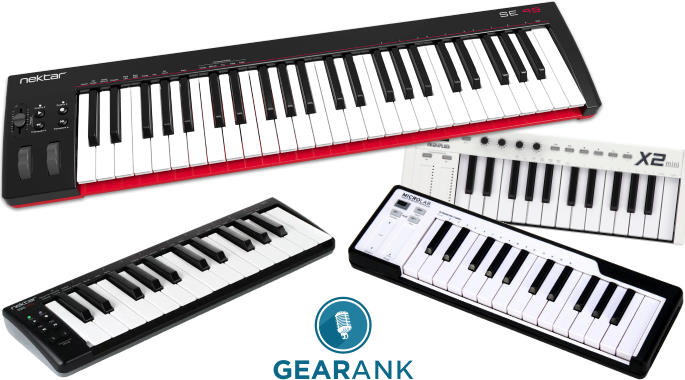
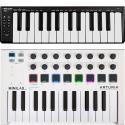
Main/Top Image: Created by Gearank.com photographs of the Nektar SE49, MidiPlus X2 Mini, Nektar SE25 and Arturia MicroLab.
The individual product images were sourced from websites, promotional materials or supporting documentation provided by their respective manufacturers except for the MiniLab MkII Touch Strips photo which was taken by the author.
Publication of our July 2022 Edition saw the following controllers removed from the recommended list above:
We’ve removed the following keyboards from the recommended list above:
We’ve removed the following keyboard due to a price increase that put it above this guide’s $100 price limit: Korg microKEY25.
Publication of our June 2021 Edition resulted in the following keyboard coming off the recommended list above, but you can still see our analysis of it: midiplus AK490.
As a result of our May 2020 update the following came off the recommended list above, but you can still see our analysis of them:
Good job. Half of these aren’t even midi capable.
All of the keyboards above are MIDI capable.
Are you referring to the fact that 5-pin MIDI ports have gone out of fashion?
We have removed the following keyboard from the recommended list above due to a price increase, but you can still read our analysis of it: Arturia MiniLab MkII 25.
This is great but I wish you would do a best under $300 article, preferably only with 61 or more keys for those of us who are not just guitar players looking to trigger a few loops and very limited samples or riff, i.e truly “play.”
We do have this on a different guide: Best 61 Key MIDI Controllers Under $300.
The following keyboard has been removed from the recommended list above due to a price increase which made it ineligible for inclusion: Korg microKEY2 37.