


Top Picks for the Best Portable Keyboard Piano 2024
Author & Contributors
Alexander Briones
I have been writing about and researching music gear for many years, all while serving as a music director at my local church. I engage in guitar playing and singer-songwriter stints, in addition to mentoring young musicians and teaching guitar and bass.
Best Portable Keyboard Piano - Arranger Keyboard Under $500
Arranger keyboards have built-in auto-accompaniment functions. Some even include backing tracks to play along with. They are the best keyboard pianos for one-man band performances and music productions.
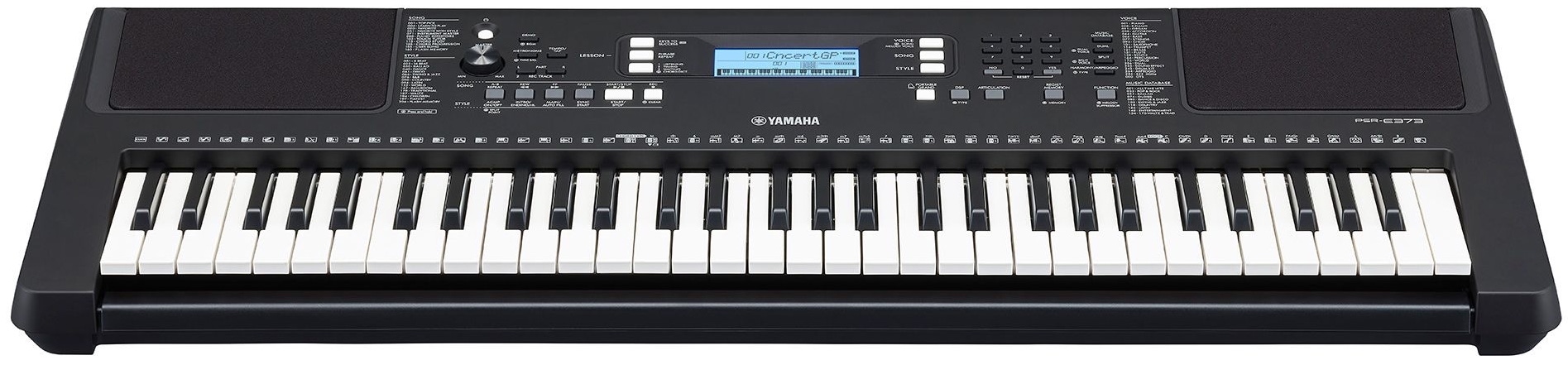
Yamaha PSR-E373 Portable Keyboard Piano
Cons
- Buttons have a soft rubbery feel
- Requires multiple button presses to cycle through settings
- No modulation and pitch controls
- Some instrument sounds are dated
Pros
- Great piano and organ sounds
- Easy to play synth-action keys
- Four Touch Sensitivity settings
- Versatile voicing and style (rhythm) options
- Built-in student-friendly lessons and features
- USB direct recording
After fiddling with his grandpa's old Yamaha PSR-E323, my then ten-year-old son ended up learning to play the main theme of Fur Elise. And he did so with just the built-in tutorial features, without help from anyone else.
His curiosity soon developed into a passion for playing and learning, so he needed a beginner-friendly keyboard. So, after much research, I ended up getting him the current generation model of his grandpa's keyboard, the Yamaha PSR-E373.
The PSR-E373 is part of Yamaha's long-running PSR line of portable keyboards. It has 61 synth-style touch sensitive keys with over 600 voices, and multiple rhythms and effects.
What sets it apart from its predecessors is its improved sound processing and the use of better sound samples. Some sounds are taken from Yamaha's more expensive digital piano keyboards.
It also has built-in lessons that teach students how to play various songs, from kid-friendly tunes to classical pieces.
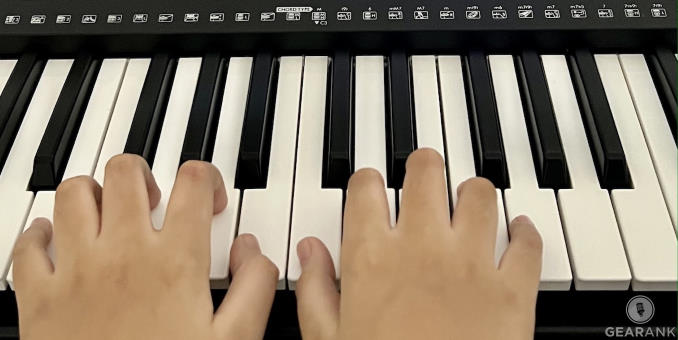
The keybed doesn't stray from standard piano size, so there's no need to adjust finger positioning when playing on stage-ready 88-key digital piano keyboards or an actual piano. But there is a big difference in playing feel because this one has a lighter "synth style" action. The keys have uniform weight and are easy to press, making for a more relaxed keyboard playing experience. Most young musicians, including my son, prefer this softer feel over the weighted keys feel of an acoustic piano.
Touch sensitivity adjusts the volume of the note you're playing in relation to how hard you press the keys. This results in more control over dynamics. Four Touch sensitivity settings are available: Soft, Medium, Hard, and Fixed. My son and I are content with the default medium setting. We can hear the dynamic differences as we lighten our key presses and pound on the keys.
Those who want the keys to respond to lighter playing will appreciate the Soft setting. Hard setting is meant for those who are used to playing acoustic pianos and weighted keys. Fixed setting disables touch sensitivity altogether, much like how old synths behave. For the price, the Yamaha PSR-E373 has good touch sensitivity, comparable to the more expensive keyboards that I've tried.
The main advantage of the PSR-E373 over its predecessors is the use of premium voices and samples. These sound samples are taken directly from their former flagship Tyros line. And because of that, there was a lot of hype about its sound quality being better than more expensive keyboards from other brands.
Thankfully, the hype turned out to be real - the main voicings sound great. Especially the grand piano sound, sampled from a costly Yamaha CFX concert grand piano.
Since my son is into classical piano pieces and taking piano lessons, having a good piano sound is our primary concern. And the PSR-E373 did not disappoint.
This portable keyboard comes with built-in lessons. It has breakdowns of popular piano standards, classical pieces, nursery rhymes, pop songs, and more. My son used this to learn Fur Elise on his own.
It has controls for phrase repeat and adjusting tempo, which helped my son focus on sections he struggles with. There's even a lesson that teaches dynamic playing. Other lessons include chord study and chord progression.
Note that while these built-in lessons are helpful, there still needs to be a substitute for a good tutor. And speaking of tutors, this keyboard is tutor and student-friendly, with its tap tempo metronome and a built-in chord dictionary. This portable keyboard piano also has headphones for quiet practice. Unfortunately, it doesn't have dual headphone outputs, which would also be great for tutors to listen in.
The Yamaha PSR-E373 has exceeded most of my expectations. It truly is instrumental in developing my son's playing and love for music - definitely worth getting.
Specifications
- USB MIDI
- 61 Synth Style Velocity-Sensitive Keys
- 48-note Polyphony
- 622 Voices,
- 12 Reverb and 5 Chorus Effects
- 2 x 4.7" Speakers, 2.5W Amp per side
- Optional Sustain Pedal
- 12V DC Power Supply (Sold Separately) / 6 x AA batteries
- Weight: 10.1 lbs.
| Website | Source | *Rating Value |
| Gearank | Alexander Briones | 96/100 |
| YouTube | Jeremy See | 95/100 |
Demo
Yamaha YPT270 Portable Arranger Keyboard
Cons
- No Touch sensitivity
- Power button can be clunky
Pros
- Piano sounds are good
- Affordable instrument ideal for beginners and for teachers
- Lots of student friendly features
- Wide array of instrument sounds and accompaniment styles
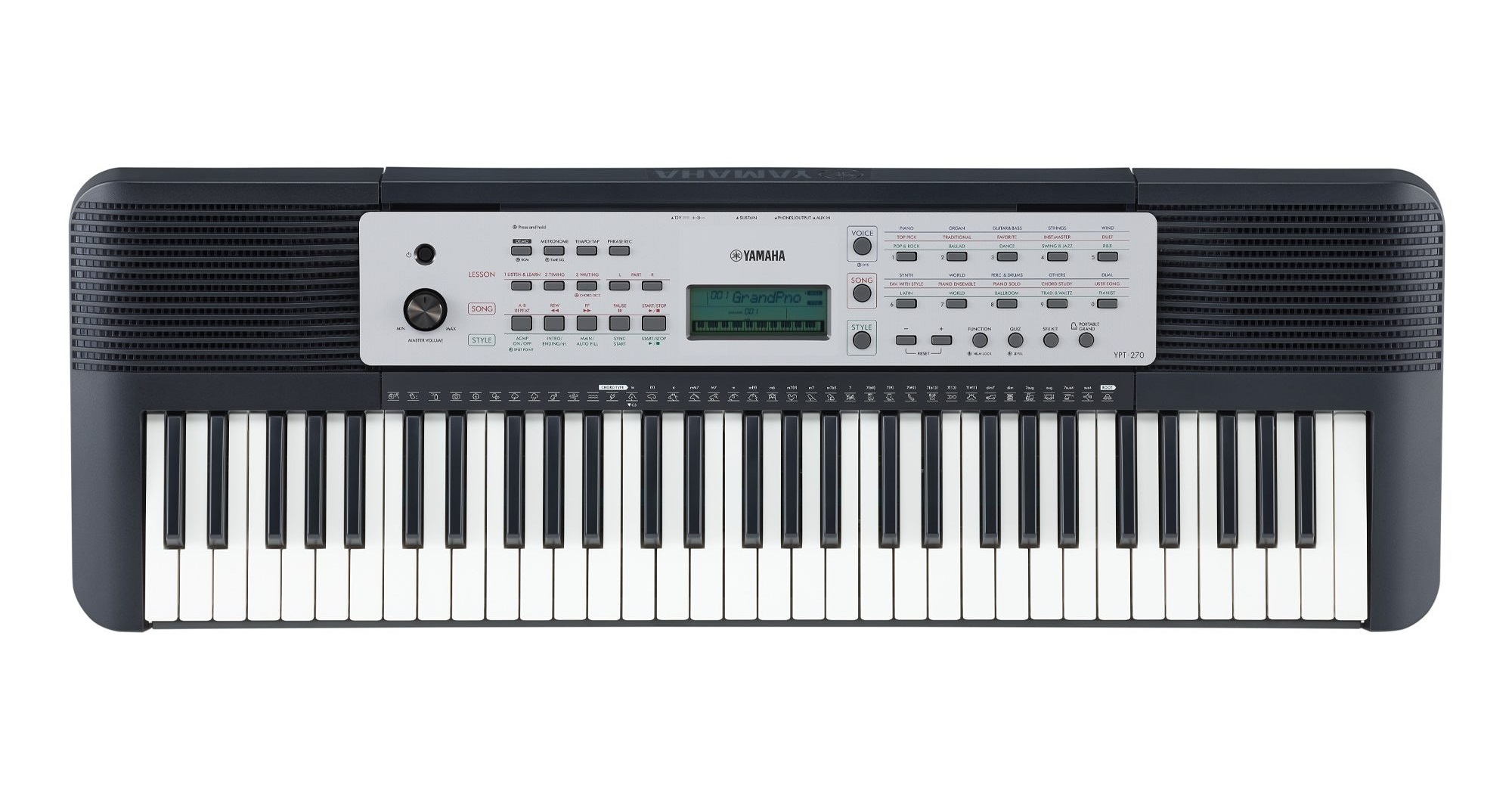
The Yamaha YPT270 is a portable arranger keyboard that offers versatility and functionality at a very accessible price point.
For the price, you're getting 61 full-size keys and 32-note polyphony, allowing for piano-style playing suitable for beginners and casual piano players.
Speaking of beginners, this keyboard comes with the Yamaha Education Suite (Y.E.S.), which provides interactive exercises and tutorials to assist users in learning to play the piano effectively. Additionally, the keyboard boasts 112 onboard songs for practice and performance, allowing players to develop their skills at their own pace.
Sound-wise, this keyboard has a lot to offer, including 401 instrument voices and 143 accompaniment styles, allowing for a wide range of sounds and backing tracks to play and learn with.
The YPT270 features a Portable Grand Piano button for added convenience, allowing users to quickly switch to the piano voice for focused practice or live performances. And the piano sound is quite good for an affordable instrument.
As expected, some instrument voices sound too artificial, but many are useful. Another downside is its complex navigation system, which can be daunting for some. Accessing various functions and settings may require more button presses. Note that the keys don't have touch sensitivity, so it won't appeal to more experienced musicians. Still, this is an excellent piano for learning and teaching beginners.
Overall, the Yamaha YPT270 offers a comprehensive set of features in a compact and portable design, making it a suitable choice for aspiring pianists and musicians seeking an affordable yet functional keyboard for practice.
Specifications
- No MIDI or Bluetooth
- 61 Synth Style Velocity-Sensitive Keys
- 32-note Polyphony
- 384 voices
- 9 x Reverb, 5 x Chorus, 6 x Master EQ, 3 x Ultra-wide Stereo
- 2 x 4.7" Speakers, 2.5W per side
- With Sustain Pedal
- PA-130 AC Adaptor Supply (included) / 6 x AA batteries
- Weight:8.81 lbs
Demo
Best Portable Piano Keyboards Under $500
All of these have MIDI to let you record on, or play sounds from your computer or tablet.
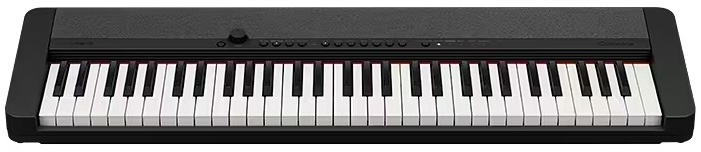
Casio CT-S1 Portable Keyboard Piano
Cons
- Fewer instrument voices
- Music rest quality feels like an after thought
- Limited features
Pros
- Decent feel/touch sensitivity
- Quiet keybed operation
- Minimalist design, intuitive controls
- Great sounding piano sounds and instrument voices
The Casio CT-S1 61 is an ultra-portable keyboard that prioritizes improved sound quality over having tons of features.
With full-size, touch-responsive keys, this keyboard offers a comfortable and expressive playing feel that even an experienced musician will appreciate. It doesn't have weighted keys, but its responsiveness is quite good, especially considering its lightweight design.
It doesn't have the usual hundreds of voices found in entry-level portable keyboards, but the 61 tones that it has are impressive for the price. I'm pleased with how it covers a lot of ground for playing different musical styles, including tones used by keyboardists in popular tracks.
Another useful feature of the CT-S1 61 is its 1-button recorder, which you can use to capture musical ideas quickly and easily for later reference or development.
The onboard speakers deliver clear sound quality. I find the sound quite enjoyable to listen to, for practice, and even for jamming and performances. It's too bad it doesn't have stereo outputs for properly connecting with PA systems, but you can get good sounds even with the phones out.
The keyboard has a class-compliant USB-MIDI port, facilitating seamless connectivity to Mac, PC, iOS, or Android devices for recording, editing, and digitally sharing music. Additionally, built-in strap pins allow for convenient portability and guitar-style playing. You can use guitar straps to play the CT-S1 like a keytar.
Overall, the Casio CT-S1 61 offers impressive sound quality without compromising portability. It's well worth getting if you want a good-sounding keyboard that's easy to carry around.
Specifications
- USB MIDI
- 61 Synth Style Velocity-Sensitive Keys
- 64-note Polyphony
- 61 Voices
- 24 Reverb, Chorus, Delay, DSP, 10 Master EQ
- 5.11 x 2.36" Speakers, 2.5W Amp per side
- Sustain Pedal (Sold Separately)
- 9.5V DC power supply (included) / 6 x AA batteries
- Weight: 4.5kg
Demo
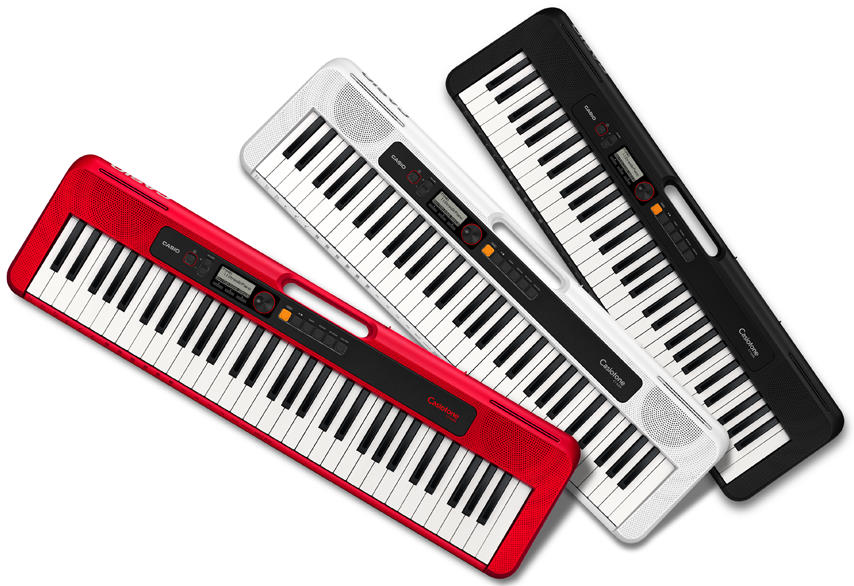
Casio Casiotone CT-S200 Portable Piano Keyboard
Cons
- Sound is based on old technology
- No Touch Sensitivity
- Limited control options
Pros
- All-in-one compact keyboard and MIDI controller
- Easy-to-play keys
- Very light and portable
- Versatile voice and rhythm options
- Slim and sleek profile
The Casiotone CT-S200 is as portable as possible, retaining a 61-key piano-style keybed. It can serve as a compact digital piano with expanded sound options: 400 voices and 77 rhythms. That's a lot of sound options for its size.
Its small profile and lightweight design make it even harder to beat in terms of features per pound, especially considering that it can also serve as a suitable MIDI controller.
Other features that add to its portability include running on 6 x AA batteries and having a carry handle.
To improve the resulting sound, it comes with different digital reverb effects. It also has a dance music mode that expands rhythm options that match what's used in modern music.
Students will appreciate its built-in lesson function that can assist in learning popular Piano pieces. It also helps that it has a sleek, modern profile that makes it stand out from among the best piano keyboards listed here.
If you're looking for a super affordable portable keyboard with good quality, check this one out.
Specifications
- USB MIDI
- 61 Piano Style Keys (Not Weighted)
- 48-note Polyphony
- 400 Tones, 77 Rhythms
- 10 Reverb Effects
- 2 x 5.1" Speakers
- Optional Sustain Pedal
- AC Adapter (Included) / 6 x AA batteries
- Weight: 7.3 lbs.
| Website | Source | *Rating Value |
| YouTube | Gearfacts | 90/100 |
Demo
Casio Casiotone CT-S300 Portable Keyboard Piano

Cons
- Some of the voicings sound dated
- Limited control options
Pros
- Portable ergonomics with handle
- Easy-to-play keys with touch sensitivity
- Has pitch bend control
- Versatile voice and rhythm options
- Good overall value
The Casiotone CT-S300 is portable digital piano that combines playability with expanded voicings and rhythm options. It packs all these features in a compact and portable profile.
Some portable digital pianos use mini-keys to make room for buttons and other controls. But this portable keyboard houses a piano-style 61-key touch response keybed that takes up most of the space.
It offers the same functionality and features as the CT-S200. But its main distinction is the addition of touch sensitivity and a Pitch Bend wheel for more expressive playing.
Compared to other portable keyboard pianos, the CT-S300 has a streamlined interface, but this doesn't mean it has fewer features. It'll take a long time to get through all its 400 tones and 77 rhythms.
This Casio portable keyboard comes with built-in lesson and MIDI connectivity. It also has a carry handle to make it easy to carry around.
The Casiotone CT-S300 is a great way to test the waters of piano playing. It can also be an excellent portable alternative to bulky digital pianos and keyboards.
Specifications
- USB MIDI
- 61 Piano Style Keys with Touch Response and Pitch Bend Wheel
- 48-note Polyphony
- 400 Tones, 77 Rhythms
- 10 Reverb Effects
- 2 x 5.1" Speakers
- Optional Sustain Pedal
- AC Adapter (Included) / 6 x AA batteries
- Weight: 7.3 lbs.
| Website | Source | *Rating Value |
| Piano Tone | Editor | 90/100 |
Demo
Things to Consider When Buying a Portable Keyboard Piano
- While there's no replacing the feel and sound of acoustic pianos, pianos are too heavy and aren't meant to be carried around. Portable keyboards are born out of necessity in this era where mobility and space saving are of high importance.
It would be wise for beginners to start with something portable. Even experienced musicians can benefit. Even pros who are torn between Synthesizer vs Keyboard arrangers have to compromise for portability.
Portable keyboards come with built-in speakers, amplifiers, and the ability to run on batteries. This allows them to be used virtually anywhere. They also come in compact profiles to limit size and weight to more manageable levels.
Note that keyboard speakers impact volume and sound quality. Don't expect the small speakers that come with keyboards to be loud and have deep sound. To make the most out of the sound of your piano keyboard, you will want to plug it into a keyboard amp or a PA system.
- Many of the keyboards sold in this price range are aimed at students. So expect them to have features that help hasten learning and more importantly, make playing fun and enjoyable. Student friendly features to look for include a metronome, auto accompaniment, headphone jack, and built-in virtual "lessons". They are valuable for someone who wants to play piano pieces and hone their playing skills.
- Arranger keyboards are those that let you arrange notes and rhythms to create music. They usually have auto-accompaniment or backing tracks that you can personalize and play with.
Most modern keyboards already have some accompaniment features. But arranger keyboards give you more control over the accompaniment, and some even allow you to edit or create yourself. Some arranger keyboards also have MIDI compatibility, allowing them to serve as controllers. If you're looking for a more portable MIDI controller, then go for one of the best 61 key MIDI controller
-
Most portable keyboards come with synth action or semi-weighted keys that balance dynamics and playability. If you prefer the feel of an acoustic piano, then having a full-size, weighted keyboard is ideal for spacing and finger tension consistency.
But be warned that hammer action keybed is heavy, so you won't find one in a travel keyboard piano. Also, they are usually more expensive. They are not priced under $500.
Most of the keyboards in this price range have softer synth style keys. The advantage that they bring is that they are easier on the hands.Touch response and sensitivity are features that separate toys from real instruments. They should be considered when looking for small keyboards piano. Sensitivity lets you control the volume of each note depending on how hard you press the keys. It lets you better express your music, much like an acoustic piano would.
-
Most portable keyboards come with 61 keys. This allows for two-handed piano-style chords and arpeggios, with a length that's still easy to carry around. Those with more keys allow for even more notes to play with, but expect them to be heavier, bulkier and not to mention more expensive.
On the flipside, there are those with fewer keys, making them cheaper and easier to carry, at the expense of having limited notes to play with.
The 61-Key configuration sits nicely in between big 88 key keyboards, and small 44 key keyboards. It has good access to notes while keeping the instrument reasonably portable.
-
Portable keyboards usually come with as many voices and sound effects that the manufacturer can put on them. And they try to do so without jacking up the price too much. As such, some of the voices or styles may not sound great to professionals, but they can be useful and fun to play with for beginners. Some even come with effects so you can personalize the sound better, or mimic the sounds used on your favorite songs.
Many also come with drum and percussion sounds. Others have pre-made rhythms that can be used to accompany you as you play. These are fun features to use, and more importantly, for training to improve your timing.
Note that there are keyboards in this price range that are similar to most digital pianos. They focus more on sound quality and playability, with more streamlined features. These often have good sounding real grand piano sounds, electric piano, upright piano, and other piano sounds. If you're interested in finding out what the the Best Digital Pianos are, we have a dedicated guide for these keyboards that play like an actual stage piano.
- Some of the latest models allow for quick recording, either direct to the keyboard itself via a memory card, or on to a computer via MIDI. While not necessary, recording can be a useful tool for practice and for songwriting. MIDI connectivity will let you use the keyboard as a controller for your MIDI device or virtual instrument software. The most common MIDI connection these days uses a USB cable. This allows for quick connection to a computer or tablet. And this is why a portable piano keyboard can also be called a USB piano keyboard. There are very few that still have 5-Pin MIDI sockets for directly plugging into hardware sound modules or Synthesizers.
- The more control options there are, the more use and variation you can get out of the instrument. However, the drawback to having more control for a beginner is that you may end up wasting time tweaking than instead of actually practicing or making music. Most students will usually just need to play traditional piano parts on the keys. But if you are into modern electronic music, you'll want mod wheels and other extras which are uncommon in this price range.
Portability
Student Friendly Features
Difference between an Arranger Keyboard and Regular Keyboard
Key Size, Action, and Sensitivity
Number of Keys
Voice, Style and Rhythm
Recording and MIDI
Mod Wheels and Other Controls
Best Portable Keyboard Piano Selection Methodology
The first edition was published in 2016. The current edition was published on Feb 21, 2024.
To be eligible for this guide and to meet the portability requirement, each keyboard had to have the option of running on batteries and have built-in speakers so you don't have to use them with an amplifier. Like we normally do, we limited our scope to keyboards that are widely available from US retailers, to make sure that you can readily get the keyboards that we recommend.
We ended up with a short list of 19 keyboards, which entailed the analysis of over 45,00 relevant ratings and reviews. All these data were analyzed and fed into the Gearank Algorithm, which gave us rating scores out of 100 that represent what the market actually feels about each instrument in real life. We then used the scores to narrow down the list further to the highest rated options. Finally, we divided our list to two sets, first of which feature the best arranger keyboards and the second one showcases the best regular portable keyboards . For more information about our methods see How Gearank Works.
About the Author and Contributors
Here are the key people and sources involved in this guide's production - click on linked names for information about their music industry backgrounds.
Lead Author & Researcher
Alexander Briones
I have been writing about and researching music gear for many years, all while serving as a music director at my local church. I engage in guitar playing and singer-songwriter stints, in addition to mentoring young musicians and teaching guitar and bass.
Keyboards are central to church music, so I literally grew up watching keyboardists play. My dad also loves keyboards as well, so through the years I’ve played on many different keyboards from Casio, Yamaha, Kawai, Roland and more. Now as a music director, I am still surrounded by keyboards, although this time around I’m the one guiding the players.
Contributors
Jason Horton: Editing and Illustrating.
Media
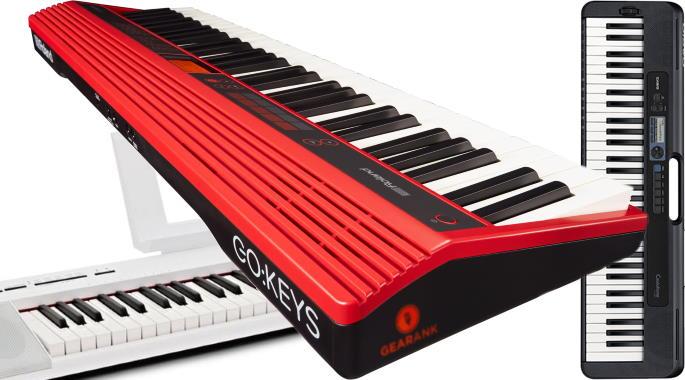
Main/Top Image: Produced by Gearank.com using photographs of the Yamaha Piaggero NP-12, Roland GO:KEYS and Casio Casiotone CT-S200.
The videos above have been embedded in accordance with YouTube's Terms of Service.
The individual product images were sourced from websites, promotional materials or supporting documentation provided by their respective manufacturers, except for the additional image of the Yamaha PSR-E373 which was supplied by the Author.
Comments
Publication of our July 2022
Submitted by Jason Horton on
Publication of our July 2022 Edition resulted in the following keyboards coming off the recommended list above:
We have removed the Korg EK
Submitted by Jason Horton on
We have removed the Korg EK-50 from the recommended list above due to a price increase that put it over the $500 price limit for this guide.
Our April 2021 Edition saw
Submitted by Jason Horton on
Our April 2021 Edition saw the following keyboards removed from the recommended list above, but you can still see our analysis of them:
I am looking to connect two
Submitted by Darren (not verified) on
I am looking to connect two key boards together for organ practising performances. Would these make a good combinations through midi connections?
The keyboards listed in this
Submitted by Jason Horton on
The keyboards listed in this guide have the wrong kind of MIDI for connecting directly to other keyboards.
What you need is a MIDI Controller Keyboard that has 5-Pin MIDI connectors - you'll find those in the following guides:
The Yamaha PSR-E263 has been
Submitted by Jason Horton on
The Yamaha PSR-E263 has been removed from the recommended list above due to being discontinued.
As a result of our April 2020
Submitted by Jason Horton on
As a result of our April 2020 update the following keyboards came off our recommended list above, but you can still see our analysis of them:
Love the roland Go Keys but
Submitted by Devin Smith (not verified) on
Love the roland Go Keys but looking for something with 88 keys and better weighting. Any recommendations?
Have you ever considered the
Submitted by Anonymous (not verified) on
Have you ever considered the new CT X-3000 from Casio and the EK-50 from Korg? Those are very promissing keyboards within the price range too.
Both of those are on our
Submitted by Jason Horton on
Both of those are on our short-list to be considered for recommendation when we next update this guide.
As a result of our latest
Submitted by Jason Horton on
As a result of our latest update the following discontinued keyboards were removed from the recommended list above:
PORTABLE? these are all huge
Submitted by hmm (not verified) on
PORTABLE? these are all huge
Good point. They are
Submitted by Jason Horton on
Good point. They are considered portable when compared to upright digital pianos like this. Also, because they have their own speakers, you don't need to carry around an amplifier to play or practice.
With today's update of this
Submitted by Jason Horton on
With today's update of this guide several keyboards were removed from our recommended list but you can still read what we have to say about them:
Nice article
Submitted by Dan (not verified) on
Nice article
Thanks Dan!
Submitted by Alexander Briones on
Thanks Dan!