
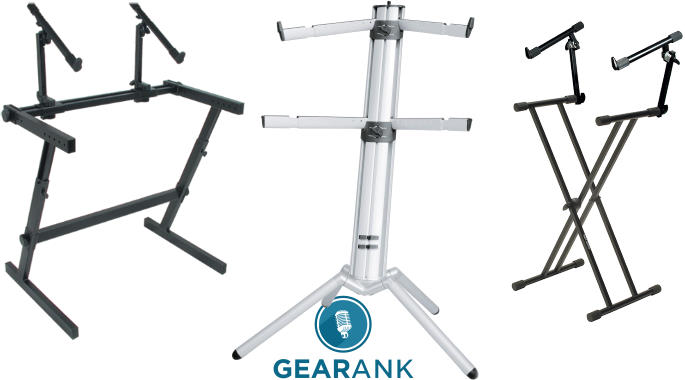
Keyboard stands have tremendous impact on playing experience. They keep your keyboards stable and position them correctly for good posture and playing comfort. As such, it is only proper to get the best keyboard stand that fits your hardware setup and positioning needs.
Disclosure
We recommend all products independently of 3rd parties including advertisers. We earn advertising fees from:
• • • • •

• • • • •
Amazon
As an Amazon Associate we earn from qualifying purchases.
• • • • •
Other Keyboard Guides
We have a range of helpful keyboard guides for you:
Here we feature market favorites grouped into popular keyboard stand categories based on their support profile and number of tiers. This format will make it easier for you to find the best stand for keyboard setups, whether for live performance or recording.
This guide focuses on keyboard stands primarily designed for 49 key instruments and up. If you need a stand for a smaller keyboard, carefully check if the minimum width can support your keyboard. Also, consider getting a music laptop stand or a correctly sized attachment.
The Best Keyboard Stands – 2024
| Gearank* | SRC* | Check Price | ||||||
|---|---|---|---|---|---|---|---|---|
| Single Tier X Style | ||||||||
 | Yamaha PKBS1 | 90 | 1700+ | |||||
| Single Tier Double X | ||||||||
 | Amazon Basics Double-X | 95 | 1700+ | |||||
| Single Tier A-Frame | ||||||||
 | Sequenz Standard-M-SV | 91 | 5+ | |||||
| Table Style | ||||||||
 | K&M Omega 18810 | 96 | 1700+ | |||||
| Single Tier Z Style | ||||||||
 | On-Stage KS7350 Z Style Keyboard Stand | 92 | 600+ | |||||
| 2 Tier X Style | ||||||||
 | Quiklok T-22 | 91 | 225+ | |||||
| 2 Tier Column Style | ||||||||
 | K&M 18860 Spider Pro | 92 | 850+ | |||||
| 2 Tier Z-Style | ||||||||
 | Quik-Lok Z-726 | 95 | 325+ | |||||
| 3 Tier Keyboard Stands | ||||||||
 | StandTastic 103KS | 88 | 60+ | |||||
Single Tier Keyboard Stands
These can be used in either standing or sitting positions, although the table-top variety suits a broader range of keyboard players' height when sitting. You want your feet to comfortably reach your pedals while the keyboard isn't too high. This section focuses on those that can accommodate different keyboard models and sizes. We did not include specialized stands for home organs as they are primarily intended for stationary use, and are often specific to particular keyboard models.
Best Single Tier X Style Keyboard Stand
These are lightweight stands that are easy to carry around, set up, and break down. They are ideal for musicians who prioritize portability and ease of use. There are downsides though which include less legroom in a sitting position, lower load / weight capacity, and limited height/width adjustments.
Yamaha PKBS1 Single X Keyboard Stand
Cons
- Not meant for big and heavy keyboards
- Not for those who hit their keys hard
Pros
- Lightweight and portable
- Easy to setup and adjust
- Good build quality
- Affordable
Being one of the biggest manufacturers of student-friendly keyboards, it follows that Yamaha knows how to make stands for beginners. The PKBS1 is exactly that, a portable and easy-to-use keyboard stand meant for hobbyists and students.
Having a single bracing makes it lightweight and easy to carry. And given its basic design, it has lower load capacity, but it should be stable enough for most portable keyboards. Since it's from Yamaha, you can be sure of its overall quality and reliability.
Being easy to set up and fold is another important advantage that makes the PKBS1 beginner friendly. All you have to do is loosen the quick change knob and set the stand up to your preferred height. The circular locking mechanism, together with the quick change knob, makes setup and height adjustments easy to do while retaining good stability.
Note that this stand is not meant to support bigger and heavier keyboards, including those that feature weighted keys. Also, if you're a keyboardist who tends to hit hard on your keys, you may want to go for a more stable stand.
All in all, the Yamaha PKBS1 is the best stand for keyboard for those who prioritize convenience and portability.
Specifications
- Load capacity: 130 lb
- Height: Adjustable from 25.63" to 38.75"
- Width: 11" to 31.5"
- Depth: Not Specified"
- Construction: Square and round steel tubing
- Weight: 13.75 lb
Best Single Tier Double X Keyboard Stand
These have two sets of bracing tubes which make them tougher and better suited to gigging, but even less suitable than single X stands for playing sitting down because many people's knees will bump into the cross bars.
Amazon Basics Adjustable Double-X Keyboard Stand
Cons
- Rubber contacts are not as durable as I would like
- Children can inadvertently loosen the locking mechanism
Pros
- High load capacity
- Sturdy and stable
- Easy to setup, fold and adjust
- Affordable
This is an X-style stand with double braces, which can be had at an entry-level price. Given its Basic label, it doesn't stray from conventional X-stand designs, but it does the job well enough to receive top marks and secure a spot in this guide.
The double-braced frame is made from steel, which ups its overall stability and reliability. It's grounded better and is not as prone to tipping over as single-braced stands. More importantly, it is sturdy enough to handle heavier instruments, including heavy 88-key digital pianos. It is secure enough for home use, and I've also seen this stand used in church setups.
In addition to steel, other parts of this stand are made from PVC, plastic, and rubber. Rubber parts are used for the contact points, and while they do get the job done, they're not as durable and can be damaged when handled poorly.
The locking mechanism is located right at the center, designed to be easy to set up, adjust and fold for storage. What's nice about this is that it is as easy to use as single-braced stands but with better load capacity and stability. The downside of its easy fold feature is that children can inadvertently loosen the locking mechanism, hence the caution from some parents.
Finally, this double-braced x-style stand is affordable and is backed by a one year warranty. If you're looking for a stand that's sturdy yet easy to use and affordable, then this is for you.
Specifications
- Load capacity overall: Not Specified
- Height: Adjustable from 27.5" to 38.2"
- Width: 13.5" to 16.5"
- Depth: Not Specified
- Construction: Steel Square Tubing
- Weight: 10.5 lbs
Best Single Tier A-Frame Keyboard Stand
These stands have a more angular A-shape support for better stability and load distribution. They also offer more legroom since load is carried by the sides and back frames, allowing for a lot of space for your legs or knees when sitting.
Sequenz Standard-M-SV
Cons
- Fixed width configuration
- Not portable
- Complex setup and breakdown
Pros
- Plenty of legroom
- Stable footing
- Quality materials
- Reliable and durable
The Sequenz Standard M-SV comes with a distinct A-frame style form factor made from lightweight steel. The main rack is secured on two angled steel poles and can be height adjusted to your preference. Being made from steel, this is a durable and reliable keyboard stand.
This configuration results in improved stability and better resistance to tipping over. It also allows the stand to support heavy keyboards and synthesizers. Its A-style form factor also provides plenty of legroom for your knees, solving a common problem that users encounter when using X-style stands. The downside to its design is that it doesn't fold as quickly, but it's not that much harder to set up.
There's also enough room for multiple rack setups should you decide to get extra racks (available on Amazon.com). This makes it a good modular base for those who are planning to grow their keyboard setup.
This particular model is medium sized, meant for keyboards with 73- to 76-keys. Note: There is a larger version designed for 88-keys which you can get from Sweetwater.
Note that this stand comes with fixed width configuration, so there's no way to narrow it down for smaller keyboards. You can adjust the keyboard holders for smaller keyboards, but it still has the same wide footprint.
It is relatively light at 18.7 lbs. while still being stable enough for stage performance. It is also quite compact, ideal for small spaces like home studios.
The Sequenz Standard-M-SV is a premium adjustable keyboard stand.
Specifications
- Load capacity: 77 lbs. per tier or 154 lbs. Total
- Height: Adjustable from 26" to 43"
- Width: 56.5"
- Depth: 19.5" (Keyboard Rack)
- Construction: Chrome-Plated Steel
- Weight: 18.7 lbs
Best Keyboard Stand - Table Style
These are much better suited to playing in a sitting position, although some can extend high enough to play standing up. The main drawback is that these require more effort to set up, break down and carry around. However, they tend to be very stable.
K&M Omega 18810 Table Keyboard Stand
Cons
- It takes a bit more effort to set up and breakdown
- Not as portable and affordable as X-stands
Pros
- Table style with less bulk and weight
- Adjustable width and height
- Stable and durable
- Good quality steel used
K&M have a reputation for quality, and the Omega 18810 is one of their best-rated offerings. This is a table style keyboard stand made from steel, so you get good stability. But it only has a single horizontal beam, supported by cross bars, so it is not as bulky and heavy as regular tables.
Another important feature is its adjustability. It can accommodate a large range of keyboard sizes from 25-key to 88-key. It can also be set to different heights without the width changes of X-style stands. As such, it can be set up for more precise and comfortable positioning. Its table style design also means that you get ample room for your knees and legs.
The downside to its adjustability is that it takes a bit more effort to tear down and get up and running. Thankfully, it can fit into hatchbacks and vans even fully set up, so there is a way to carry it around without having to break it down.
Note that this stand is convertible into a 2 Tiered keyboard stand with the addition of the K&M 18811 Stacker, which is available from Sweetwater and Amazon.
K&M Stacker from Amazon.com.
Other nifty features include having 4 Velcro tapes to guide cables and engraved height scale.
The K&M Omega 18810 is priced a bit higher than many other stands. But it is worth the extra money, given its heavy-duty build, stability, and adjustability.
Specifications
- Load capacity: 176 lb (80 Kg)
- Height: Adjustable from 23.6" to 40.1" (600 mm to 1,020 mm) via spring-loaded clamping knobs
- Width: Adjustable from 7" to 31.1" (180 mm to 790 mm)
- Depth: 13.6" (345 mm)
- Construction: Steel
- Weight: 20.9 lb (9.5 kg)
| Website | Source | *Rating Value |
| YouTube | Mike Barden Piano | 96/100 |
| Gearspace | James Lehmann | 94/100 |
Best Keyboard Stand - Z Style Single Tier
These are sturdier than X-Style stands and some can be raised and lowered to accommodate both sitting and standing positions.
On-Stage KS7350 Z Style Keyboard Stand
Cons
- A bit more complex to set up and break down
- Be careful not to lose parts when broken down
Pros
- Good balance of stability and portability
- Independent width and height adjustment options
- Solid and wobble free when set up properly
- Good load capacity
Z-style stands are well regarded for balancing stability with portability, hence the reason for their widespread use in gigging. The On-Stage KS7350 hits the sweet spot nicely with its sturdy profile and simple setup.
For a stable keyboard / digital piano stand, it's not much harder to set up. Its Z-style stand profile is well grounded, resistant to wobbling, and hard to tip over. Load capacity is also quite good, so you can use it as a piano keyboard stand. It can handle heavier professional 88-key keyboards and digital pianos without any issues.
Also noteworthy is its adjustable center box, which lets you adjust height and width independently. It's viable for keyboards of different sizes, with precise height adjustments and leveling.
It is designed for 55 key keyboards and up. However, many 49 key keyboards will also fit. Compare your keyboard width to the specification below before buying it for a smaller keyboard. Note that there is no way to adjust depth for big deep keyboards.
It is not as stable as table style stands, but the KS7350 breaks down into flat sections. This makes it easier to transport. Its z-profile design also provides good legroom.
On-Stage attachment parts are available for adding more tiers, racks, side shelves, and even monitor stands.
If you need a reliable single-tier Z stand and will be transporting it to and from gigs, this is your best option. It can also be a good base platform for a modular home keyboard setup.
Specifications
- Load capacity: 375 lbs
- Height: adjustable from 24" to 38"
- Width: adjustable from 21" to 36"
- Depth: 16.75"
- Construction: ¾", 1", 2" welded tubing
- Weight: 17.35 lbs
2 Tier Keyboard Stands
These are meant to hold two keyboards in a single stand while maintaining stability and adjustability. One of the common themes we see in reviews for keyboard / piano stands with 2 tiers or more is that some musicians aren't careful enough to prevent over-balancing the top levels by overloading them or by removing a lower keyboard when one is sitting on top.
Best 2 Tier Keyboard Stand - X Style
These are Double Tier Stands (X Style) with attachments to create an extra level. One thing that stood out in our survey data is that double x-style stands are consistently rated lower than their column or z-style counterparts, and that is primarily due to stability issues - the trade-off is that they cost less than the other types and are easier to set up.
Quiklok T-22 Double Braced X 2 Tier Keyboard Stand
Cons
- Limited width and height adjustments
- Not viable for heavy instruments
- Not for those who hit their keys hard
Pros
- Portable and lightweight
- Double-braced X-frame
- Simple setup and folding
- Second tier tilt adjustment
The Quiklok T-22 is an X style double keyboard stand with two braces and two tiers. It is part of their "T-Rex" line of stands that utilizes their "dino-bite" locking disc which stabilizes the stand in multiple positions.
The main tier works much like a regular X-stand, with the locking mechanism positioned at the center, allowing for nine height adjustment positions that also affect width. The second tier has tilt adjustment, and it is attached to the main X-frame via the back.
Since it is an X-stand at its core, it provides the same level of portability and simplicity. It is easy to set up and break down, but with a bit more complication when setting up the second tier because it requires having the right combination of width and angle to work. The main double-braced tier is heavy duty, and should be capable of handling most portable keyboards and even digital piano keyboards, while the second tier is limited to lighter ones.
On the other hand, it also suffers from the same drawbacks, which include limited height and width adjustments. It's also not as stable as table and z-style stands, which can be a big issue especially for those who like to play hard when performing. Extra effort is needed to check and tighten the locking mechanisms. Load capacity is limited, so this is not viable for those that use big and heavy keyboards.
The Quiklok T-22 is a good quality portable 2-tier stand that you can get for a very reasonable price, definitely worth checking out.
Specifications
- Load capacity overall: 177.7lb
- Load capacity 2nd tier: 75 lbs
- Max Height: Not Specified
- Construction: Steel and Round Steel Tubing
- Weight: 14.45 lbs
- Support arms:: Round Steel Tubing with Tilt Adjustment
Best 2 Tier Keyboard Stand - Column Style
Although generally more expensive than x-style double stands, column stands typically get higher ratings.
K&M 18860 Spider Pro Column Stand for Keyboard
Cons
- Bulky and heavy
- Premium price tag
Pros
- Simple one-piece design
- High load capacity
- Solid and stable two tier arm support
- Versatile height and setup adjustments
The K&M 18860 Spider Pro is a double keyboard stand with an angled metal column as its main frame. This column has four spider-like legs that provide good stability and balance. And it has arms that extend from the column that serve as instrument holders.
The main advantage of this design is its one-piece simple design and structural stability. Everything folds into the main frame, so you don't have to worry about losing parts, making it easier to set up and fold for transport. Note that it is heavier and bulkier than basic X-stands, but it is portable enough for regular gigging use.
This design offers plenty of room for your knees and pedals when used in the sitting position, and being adjustable up to 51.5" it is also suitable for playing standing up. The arm supports are a bit too wide for 25-Key keyboards, but they can still fit when you set up the arms with trays. Even with limited width adjustments, the arms are stable enough to support 49-key and up keyboards without any issue. Built-in cable management is another nifty feature of this stand.
The two tiers have height adjustable support arms, so you can set it up the way you want to. And the arm supports feel very solid, capable of handling heavier synths and digital pianos with little to no wobbling issues. The arms are also stable enough even for hard hitting keyboardists. K&M also sells other attachments that include laptop and iPad holders.
The price is on the high side, but given its premium quality the K&M 18860 Spider Pro is well worth the investment.
Specifications
- Load capacity overall: 231 lb (105 kg)
- Load capacity each tier: 77 lb (35 kg)
- Height: Maximum 51.5" (1,310 mm) - both tiers are infinitely variable
- Width: Adjustable from 26.4" to 37" (670 mm to 940 mm)
- Depth: Adjustable from 11.8" to 18.5" (300 mm to 470 mm)
- Construction: Anodized aluminum
- Weight: 22.2 lb (10.06 kg)
- Support arms: One pair has an adjustable tilt angle of 15°
| Website | Source | *Rating Value |
| Youtube | Joe Cosas | 94/100 |
Best 2 Tier Keyboard Stand - Z-Style
These typically have a higher load bearing capacity over column style stands - this is important not only if you use 2 heavy keyboards, but also if you want to add a lot of accessories such as laptop holders and microphone stands.
Quik-Lok Z-726 2 Tier Keyboard Stand
Cons
- No width adjustments for the lower tier
- 2nd tier must be set properly
Pros
- 2nd tier has adjustable width, height and angle
- Solid and stable Z-style frame
- Provides ample legroom
- First tier can handle heavy and bulky synths and keyboards
The Quick-Lok Z-726 2 is a two tier keyboard stand that follows a Z-profile with a 19.75" depth for good stability. The Z-frame is crafted from 30mm x 50mm brace steel tube, which allows the main tier to handle heavy keyboard instruments without issue.
The main tier has height adjustment and provides ample legroom. It works nicely for standing and for sitting position. Note that side to side width of the main tier is fixed at 34", so do check the size of your keyboard first before buying. A wider version of this stand is available, called Z-726L, it has side to side width of 44".
The top tier arms are clamped on the back bar of the main tier, and is 12" deep. Both the height and width of the top tier are adjustable, for use with a broader variety of keyboards. In addition, it also supports angle adjustment, so you can position the top tier keyboard to your preference. Even with all these adjustments, the 2nd tier is quite stable when properly set.
The Quick-Lok Z-726 makes for a great double keyboard stand for those that use lighter keyboards on the top tier.
Specifications
- Load capacity overall: 250 lb
- Load capacity top tier: 75 lb
- Main Stand Height: 26.3", 27.5", 28.7", 29.9", 31.1", 32.3", 33.4"
- Top Tier Height: 9.2", 10.2", 11.2", 12.2"
- Top Tier Width: Adjustable from 21" to 37”
- Depth top tier: 12"
- Depth main tier: 19.75"
- Construction: Welded steel tubing
- Weight: 26.5 lb
| Website | Source | *Rating Value |
| YouTube | miAim The Improvised Line | 90/100 |
Best 3 Tier Keyboard Stand
We found that in general, stands with 3 tiers or more receive lower ratings from customers than 2 tier stands do. This holds true across nearly all review sources we examined. It seems that this is a reflection of the additional complexity of setting up and pulling down. And the fact that the more tiers you add, the less stable they become. Although 3 tier stands can come in other formats, we only found A-Frame style stands rated high enough to be included in this edition of the guide. These 3 tier stands let you use up to three keyboards, but keep in mind that the top two tiers are often designed for lightweight keyboards.
StandTastic 103KS 60" A-Frame 3 Tiered Keyboard Stand
Cons
- Same width for all three tiers
- Complex setup and breakdown
Pros
- Adjustable height, width, depth, and angle
- Stable 3-tier design with high load capacity
- Can fold into included carry bag for transport
- Good resistance to bounce and wobble
The StandTastic 103KS lets you use three keyboards securely on a single stand in three adjustable tiers. What makes it special is how versatile it is in terms of adjustability while keeping the structure stable enough to hold 3 keyboards.
All three tiers let you adjust height, angle, width, and depth - something that you won't get from conventional stand designs. Height adjustments are made via a mounting mechanism that you lock in place in your preferred height position. When mounting the arms, there is a three angles to choose from, which expands the stand's positioning flexibility further. Beneath the arms are screws that let you adjust depth, which allows for handling of thick arranger keyboards. Width adjustment is done on the two main frames, and it can be adjusted to carry even wide 88-key keyboards.
Given its adjustability, setting up can be quite complicated, especially for first-time users. But once you get more familiar with it, setting up and folding the stand gets easier. Speaking of folding, this big 3-tier stand folds neatly and fits inside the included compact carry bag. This means that the 103KS is suitable for gigging, but you'll have to spend extra time setting up the stand. There are practical ways of speeding up the process, like by placing marks on your adjustments so it is viable.
Being an A-Frame stand, width adjustments apply to all three tiers, so you will need to use a keyboard tray if you want to mix wide keyboards with a small one.
It can handle up to 70 lbs on each tier, which is quite a lot. Some retailers even mention that it can handle up to 100 lbs per tier. And it does so with minimal bounce and wobbling. More importantly, it remains stable and w even when fully loaded with 3 keyboards.
If you're looking for a versatile keyboard stand with three-tiers and has good portability, the StandTastic 103KS is for you.
Specifications
- Load capacity: 70 lb each tier
- Height: Up to 57"
- Width: Up to 36"
- Depth: 12" to 22"
- Construction: Steel Frame
- Weight: 21 lb
| Website | Source | *Rating Value |
| YouTube | Honest Gears Review | 92/100 |
Things To Consider When Buying A Keyboard Stand
Strength. The heavier your keyboards are then the stronger your stands will need to be - don't skimp on budget or weight when it isn't worth the risk of having an expensive keyboard drop to the floor - make sure you check the weight specifications of a stand before you buy it. Also ensure your stand is rated for a greater load than the weight of your keyboard because it has to hold up under the combined forces of the keyboard weight and you playing on it. You want nothing less than a strong and reliable stand that's suitable for your best keyboard workstation
Size & Weight. There are two size issues to consider, yours and that of your keyboards. If you are a tall person and you play sitting down, some stands will have parts that get in the way of your legs or knees making it difficult to play and use your pedals easily. If you have a small keyboard, make sure the stand can adjust down to the width you need - you generally want the minimum width of your stand to be about 4" less than your keyboard width. Also make sure your stand, particularly 2nd or 3rd tiers, are rated to take the weight of the keyboards you want to use on them.
Adjustability. Different stands have different adjustable parameters. X-stands for example gets lower as you widen the width. While it can support longer 88-key digital pianos, it will do so at low sitting position. If you're using keyboards of different sizes, it pays to look into how adjustable the stand is, most stands have height and width adjustments, others allow you to set depth and support arm angle. Adjustability is the main weakness of a simple DIY keyboard stand.
Where will you be playing? If you're going to be regularly setting up and packing down, then you need to look for ones that are easy to set up, tear down, and transport. For example, four legged stands tend to be quite sturdy but at the cost of taking more time to set up and pull down. On the other hand, if you mainly play at home, then any sturdy stand will do the job.
Number of keyboards. When you have more than one keyboard you're either going to need a multi-tier stand or multiple stands. If you prefer to have all your keyboards in front of you, then go with a multi-tier option, otherwise you can use multiple stands placed approximately at right angles to each other - sometimes referred to as an 'L' configuration.
Stability. With multi-tier stands, you have to be careful about which keyboards you place on each level to ensure the center of gravity remains as close as possible to the center of the stand. Generally, this means placing the lighter keyboards on the higher tiers.
Accessories. Many keyboard stands have optional accessories for holding things like laptops, tablets, microphones and additional tiers. If you plan to use these you will need to take the combined weight of accessories and the items they hold into account when choosing your stand.
Different kinds of stands. The main types of stands are Single X, Double X, Column, Table or T Style, Z-Style and A-Frame. The lighter X types are generally cheaper but less stable that the other types.
Best Keyboard Stand Selection Methodology
This guide was first published in 2015.
We began our quest of finding the best keyboard stands by examining the most popular and highest rated keyboard stands at major online American retailers. For this edition, we ended up with 81 keyboard stand candidates for in-depth analysis. We then collected and analyzed relevant reviews, ratings and forum discussions, which tallied to over 76,500 sources, this almost doubled compared to the previous edition. All these data were then fed that into the Gearank Algorithm to create a Gearank Rating score out of 100 for each stand. Finally, we selected the highest rated stands to recommend within each category. For further information about our methods see How Gearank Works.
About the Author and Contributors
Here are the key people and sources involved in this guide's production - click on linked names for information about their music industry backgrounds.
Lead Author & Researcher
Alexander Briones
I have been writing about and researching music gear for many years, all while serving as a music director at my local church. I engage in guitar playing and singer-songwriter stints, in addition to mentoring young musicians and teaching guitar and bass.
At church, we always put the keyboard back to storage after using, so for a long time we’ve been using easy to fold double-braced X stands. At home, I’ve tried different z-style and cabinet stands, but I’ve reverted to a double-braced X stand since it saves space and is easier to move.
Contributors
Jason Horton: Editing and Illustrating.
Media
Main/Top Image: Compiled using photographs of the Quik-Lok Z-726, K&M 18860 and Quiklok T-22.
The individual product images were sourced from websites, promotional materials or supporting documentation provided by their respective manufacturers

These stands came off the recommended list when we published the October 2022 Edition:
Publication of our February 2022 Edition resulted in the following stands coming off the recommended list above:
Our March 2021 update resulted in the following stands coming off the recommend list above, but you can still see our analysis of them:
Where can I find replacement parts for Stay Tower 1300 3-Tier Keyboard Stand? Looking for Tower Flexible Rod for Microphone and 2 sets of Tower Arms Curved 290mm+Angle Base Tower.
You could try contacting the company via their website’s contact form.
As a result of our March 2020 update, the following stands came off the recommended list above, but you can still read our analysis of them:
Have you looked at the Rockville RKS30X Double X? Was considering for my P-115.
I decided to publish our rating for it – it’s not quite high enough to go on our recommended list – see the current rating here: Rockville RKS30X.
Where can I get a stand with the second tier adjustable down to two to three inches above my main keyboard. These second and third tiers are really for show, in bands. I do a single act. Need the other keyboard right above the main. If I could put another keyboard on the main it would be perfect. But as you know with all the buttons etc it is not possible. I play a Motif XF7. Help.
Yes. Definitely the K&M Spider Pro. I own one and love it. Only wish they made a 3 tier. However, you can buy a 3rd arm and add it in. It’s a little tight for me but if you want your keyboards stacked tightly together, the K&M is your stand. Well-made, German engineered. A little pricey but well worth it.
K&M Spider Pro
Thanks for the summary. You’ve missed the pro stand that everyone in Europe loves and is gaining traction in the US – Jaspers made in Germany. We have to order them from Europe but that’s no big issue. They are sold direct and through the major music dealers like Thomann, Musicstore.de and recommended on Gearslutz and Jason Rudness. All aluminum, adjustable, sort of portable and built to last. http://www.jaspers-alu.de/
Thanks for the tip Stephen. We didn’t accidentally ‘miss’ Jaspers, we deliberately only included brands that were widely available from US retailers at the time. If they become widely available in the USA then we will include them in our product research when we next update this guide.
The QL-723 needs to be on the list for three-tier stands.
Just letting everyone know that the QL-723 has been included in the finalist list of stands that we are evaluating for our upcoming 2017 update of this guide.
Thanks for the tip Brett.
I’ve had a look around and most retailers don’t sell it – in fact I only found 4 reviews which isn’t enough for it to have a Gearank score, so we won’t be able to include it unless more shops sell it.
For anyone who’s interested, you can get more information on the QL-723 at http://www.quiklok.com/catalog/?p=productsMore&iProduct=516&sName=QL-723
I own the QL-723. I’ve had issues with this stand after maybe 6 times out on gigs. First, the screws on the “X” part of the stand or the base that holds up the 2nd tier could not tighten very well thus causing the 2nd and 3rd tiers to be shakey. I eventually stripped out the screws and the receiver nut inside the frame on a gig. Fortunately for me, there was a Home Depot close by so I was able to purchase threaded rods and slipped them through the receiver and put wingnuts at both ends so that I could keep the 2nd tier stable. Speaking of the 2nd tier, the screws holding up the arms have stripped out as well which won’t stop the keyboard on the second tier from falling onto the keyboard on the first tier. I have three phone calls and an email into QuikLok to inquire about replacement parts but their customer service department has yet to call me back. Would I buy another one of these stands or recommend them? Probably not unless they come up with a better design to prevent the screws from stripping out.
Is that design the same as on the 623, so they will have the same issue?
Thanks for the advice Johnny!